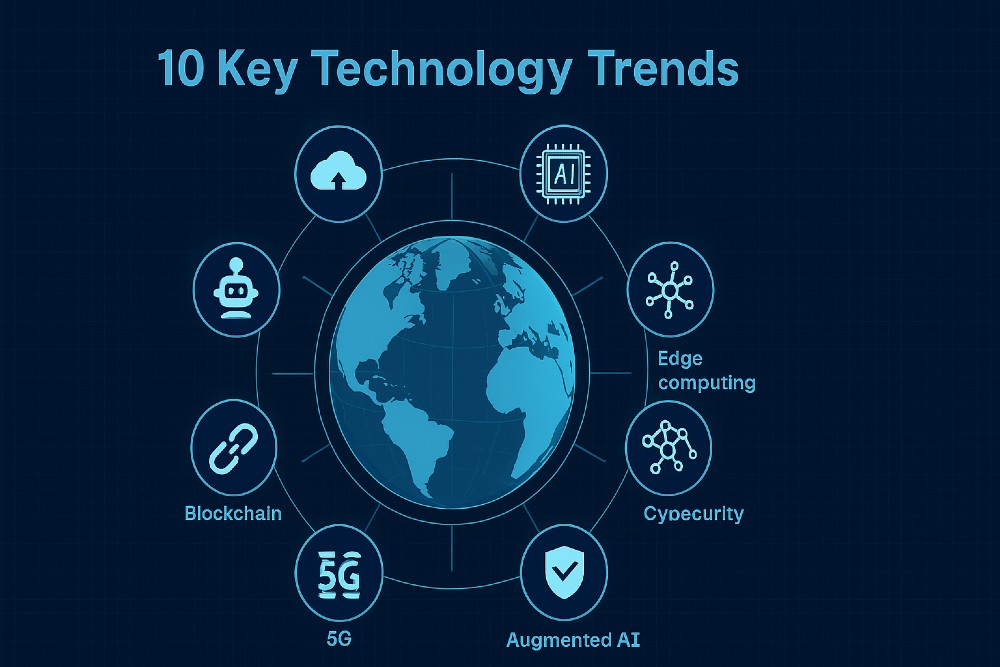
10 Key Technology Trends in 2026 That Will Change Business
Technology doesn’t wait for businesses to catch up. The companies that spotted cloud computing early in 2010 dominated their industries by 2015. The ones that ignored mobile-first design lost customers they never got back. 2025 is another one of those moments — and the trends below aren’t predictions. They’re already happening. The question is whether your business is positioned to use them or about to be disrupted by competitors who are.
Quick Verdict Table
| Technology Trend | Business Impact | Who It Affects Most | Urgency Level |
|---|---|---|---|
| Agentic AI | Replaces entire task workflows | Every business with repetitive ops | High — happening now |
| Quantum Computing | Breaks current encryption, solves complex logistics | Finance, pharma, logistics | Medium — 2-3 years |
| Spatial Computing | Changes how customers experience products | Retail, real estate, manufacturing | Medium — early adoption now |
| Cybersecurity Mesh | Protects distributed remote teams | Every business with remote workers | High — attacks increasing |
| Green Tech & ESG | Affects investment, talent, and regulation | Publicly listed + B2B suppliers | High — regulatory pressure |
| Edge Computing | Speeds up real-time data processing | IoT-heavy, logistics, healthcare | Medium-High |
| Hyperautomation | Automates cross-department workflows | Operations-heavy businesses | High |
| 5G Business Applications | Enables new real-time services | Manufacturing, logistics, retail | Medium-High |
| AI-Generated Synthetic Data | Trains AI without privacy risks | Healthcare, finance, legal | Growing fast |
| Human-AI Collaboration Tools | Changes how teams work daily | Every knowledge worker business | High — already mainstream |
Why Do Technology Trends Matter More in 2025 Than Ever Before?
Because the gap between early adopters and late movers is compressing.
In previous technology cycles, a business had 5-7 years to adopt a new trend before it became a competitive disadvantage. Cloud computing took almost a decade to become the default. Social media marketing had a long runway.
That window is now 18-24 months for most technology shifts. AI tools that were experimental in early 2023 became industry standard by mid-2024. Businesses that waited are already behind — not slightly behind, but structurally behind in cost efficiency, output capacity, and customer experience.
So the trends below are not a “future planning” exercise. They are a “what do we do in the next 12 months” business decision.
Trend 1: Agentic AI — When AI Stops Assisting and Starts Acting
What is Agentic AI and Why Should Business Owners Care Right Now?
Most people know AI as a tool that answers questions or generates content when you ask it. Agentic AI is different. It receives a goal and executes a multi-step process to achieve it — without you directing each step.
Tell a regular AI: “Write an email to this prospect.” It writes the email. You send it.
Tell an agentic AI: “Book 15 qualified discovery calls this month.” It identifies target prospects, personalizes outreach for each, sends the first email, follows up based on response behavior, handles scheduling, and updates your CRM — without you touching it after the initial instruction.
That’s not an exaggeration. Salesforce Agentforce, Microsoft Copilot Studio, and Relevance AI are all live platforms doing exactly this right now.
What this means practically for business:
Sales teams that previously needed 5 outbound reps to run a high-volume prospecting operation can now run the same volume with 2 reps and one agentic AI setup. The reps focus on actual conversations and closing. The agent handles everything before the call.
Operations teams can set agents to monitor inventory levels, trigger purchase orders when stock hits a threshold, communicate with suppliers for confirmation, and update the inventory system — a process that previously required a dedicated operations coordinator checking dashboards daily.
What not to do: Don’t deploy AI agents without defined boundaries. An agent with access to your email, CRM, and calendar but without clear rules about what it can and cannot do autonomously will eventually make a decision you didn’t sanction. Start with narrow, well-defined tasks. Expand scope only after observing behavior for 30+ days.
The businesses implementing agentic AI correctly right now are not cutting staff. They’re handling 3x the workload with the same team — which is a growth advantage, not a cost-cutting story.
Trend 2: Cybersecurity Mesh — Because Remote Work Created Holes You Can’t Ignore
Why Is Traditional Cybersecurity Failing Modern Businesses?
Old cybersecurity model: protect the office. Build a wall around the building’s network. Everyone inside the wall is trusted. Everything outside is blocked.
That model collapsed when remote work became permanent. Now employees access company systems from home networks, coffee shops, personal laptops, and mobile devices. There is no single wall to protect. There are hundreds of individual access points, each one a potential entry.
The result: cyberattacks on businesses increased by 38% in 2023 according to Check Point Research, with small and mid-size businesses becoming the primary target because they have weaker defenses than enterprises but more valuable data than individuals.
Cybersecurity mesh is the response to this.
Instead of protecting one central perimeter, cybersecurity mesh protects every individual access point separately — each device, each user identity, each application — and connects them through a unified security management layer.
Practically, this means three things for your business:
Zero Trust Architecture — Every user, even internal employees, must verify identity every time they access a system. No automatic trust based on being inside the network. Tools like Okta (identity verification) and Cloudflare Zero Trust (network security) implement this. Okta starts at $2/user/month. Cloudflare Zero Trust has a free tier for teams under 50.
Endpoint Detection and Response (EDR) — Software installed on every company device that monitors behavior in real time and isolates a device automatically if it detects unusual activity. CrowdStrike Falcon is the enterprise leader. Malwarebytes EDR is the small business accessible version at $6.99/device/month.
Security Awareness Training — 82% of breaches involve a human element (Verizon Data Breach Report 2023). An employee clicking a phishing link bypasses every technical defense. KnowBe4 runs automated phishing simulation tests and training modules. Employees who fail the simulation get targeted training. This is not optional — it is the most cost-effective security investment most businesses can make.
What businesses get wrong: Treating cybersecurity as a one-time setup. Install the firewall, done. Security is an ongoing practice, not a product. Threats evolve monthly. Your defenses need to evolve with them.
Trend 3: Hyperautomation — Connecting Every System So Nothing Falls Through the Gap
What’s the Difference Between Basic Automation and Hyperautomation?
Basic automation: automate one task. Set up an email sequence that sends when someone fills out a form. Connect Shopify to your shipping software so orders flow through without manual entry.
Hyperautomation: connect every system and automate entire workflows that cross multiple departments, multiple tools, and multiple decision points.
Here’s an example of what hyperautomation looks like end-to-end in a service business:
A new client signs a contract → DocuSign triggers a Zapier workflow → Zapier creates a project in Asana, a client folder in Google Drive, sends a welcome email via HubSpot, creates an invoice in QuickBooks, adds the client to Slack with the right channel access, and notifies the assigned team lead — all within 90 seconds of the signature, with zero human action required.
Individually, each of these is basic automation. Connected together, they eliminate an entire onboarding coordinator role or free that person for higher-value work.
The tool that makes this possible at scale: Zapier for mid-complexity workflows (connects 6,000+ apps, starts at $19.99/month). Make (formerly Integromat) for complex, conditional workflows with more control over logic ($9/month, significantly more powerful than Zapier for multi-step processes). Microsoft Power Automate if your business runs on Microsoft 365 (included in most M365 business plans).
Where businesses underuse hyperautomation:
HR processes — offer letter generation, onboarding task assignment, equipment request routing, and access provisioning can all be automated end-to-end. Most companies still do these manually.
Finance processes — invoice approval routing, expense categorization, and monthly report generation still require human hours in most mid-size businesses despite being fully automatable.
The ROI calculation: If hyperautomation saves 3 hours/day across a 10-person team, that’s 30 hours/day of recaptured human time. At an average fully-loaded cost of $35/hour, that’s $1,050/day or roughly $270,000/year in productivity value from tools that cost $100-300/month.
Trend 4: Spatial Computing — The Next Interface After Mobile
Is Spatial Computing Just About VR Headsets or Is There More to It?
The VR headset is the hardware. Spatial computing is the capability — the ability to blend digital information with the physical world in three-dimensional space.
Apple Vision Pro launched in early 2024 and immediately showed what spatial computing looks like in a business context. Not gaming. Not entertainment. Surgeons reviewing 3D patient anatomy before an operation. Architects walking clients through a building before it’s built. Industrial technicians seeing repair instructions overlaid on the actual machine they’re servicing.
That last one is significant for manufacturing and field services.
GE Aviation uses spatial computing tools to guide aircraft engine technicians through complex repair procedures. The technician wears an AR headset and sees step-by-step instructions overlaid directly on the engine — the right bolt highlighted, the torque specification shown next to it, the next step appearing only after the current one is confirmed. Error rates dropped significantly. Training time for new technicians was cut in half.
For retail: Spatial computing changes the product experience. IKEA’s AR app lets customers place furniture in their actual room before buying. Return rates on furniture purchased through the AR feature are 30% lower than standard online purchases because customers know it fits before they buy.
For real estate: Virtual property tours with spatial computing aren’t 360-degree photos (that’s old tech). They’re full spatial models where a buyer walks through a property on a headset as if physically present — from anywhere in the world. For commercial real estate leasing, this eliminates geography as a barrier to closing deals.
What businesses should do now: The headset hardware is still expensive for mass deployment ($3,500 for Apple Vision Pro). But the underlying capability — augmented reality overlays accessed via mobile — is already affordable and available through platforms like PTC Vuforia (industrial AR) or Zappar (marketing AR). Start with mobile AR before investing in headset hardware.
Trend 5: Edge Computing — Why Processing Data Closer to the Source Changes Everything
What Problem Does Edge Computing Actually Solve?
The problem is latency — the delay between something happening and a system responding to it.
When all data goes to a central cloud server for processing, there’s a delay. For watching a Netflix video, a 200-millisecond delay is invisible. For a self-driving vehicle making a braking decision, a 200-millisecond delay is a collision. For a factory machine that needs to stop when a safety sensor triggers, that delay is an injury.
Edge computing moves the processing power to the device or local hub where the data is generated — so decisions happen in milliseconds without a round trip to the cloud.
Where this matters for non-technical businesses:
Retail: Smart checkout systems that recognize products and process payment without a cashier depend on edge computing. Amazon Go stores process camera data locally at each store — if it depended on cloud processing, the checkout experience would lag noticeably. Standard Cognition and Zippin offer this technology to retailers now.
Healthcare: Remote patient monitoring devices that track vitals and detect anomalies need to process data on-device or at the clinic level. If a cardiac monitor has to send data to a cloud server and wait for a response to detect an irregular heartbeat — the delay matters. Edge processing makes real-time local detection possible.
Manufacturing quality control: Camera systems that inspect products on the assembly line for defects process thousands of images per minute. Cloud processing can’t keep up with production line speed. Edge AI chips mounted on the line process images locally and flag defects instantly. Landing AI and Cognex provide these systems.
What businesses should assess: If your operation involves real-time physical decisions, sensor data, or high-frequency data collection — edge computing is relevant and likely worth evaluating. If your business is primarily software, remote, or knowledge-based — cloud-first remains the right architecture and edge computing is not yet a priority.
Trend 6: Quantum Computing — Not Ready for Your Business Yet, But Ready to Affect It
Should Businesses Worry About Quantum Computing in 2025?
Not worry. Prepare.
Quantum computers use quantum bits (qubits) that can exist in multiple states simultaneously, unlike classical bits that are either 0 or 1. This makes them exponentially faster for specific problem types — particularly optimization problems and cryptography.
They are not general-purpose computers. A quantum computer will not replace your laptop or your cloud server. But for specific calculations — drug molecule simulation, logistics route optimization across millions of variables, financial risk modeling — they solve in minutes what would take classical computers thousands of years.
IBM Quantum and Google Quantum AI already offer cloud-based quantum computing access. IonQ is publicly listed and offers quantum computing as a service. These are not consumer tools — they require quantum programming knowledge. But enterprise businesses in logistics, finance, and pharmaceutical research are actively running quantum experiments alongside classical systems right now.
The one thing every business needs to know about quantum in 2025:
Current encryption standards — specifically RSA encryption, which secures most internet communications, banking transactions, and business data — are theoretically breakable by a sufficiently powerful quantum computer. This is called the “harvest now, decrypt later” threat: adversaries are collecting encrypted data today, planning to decrypt it when quantum computers are powerful enough.
What to do: Start migrating to post-quantum cryptography (PQC) standards. NIST (National Institute of Standards and Technology) finalized its first post-quantum cryptographic standards in 2024. Businesses that handle sensitive long-term data — legal, medical, financial — should work with their IT security teams or vendors to assess PQC readiness now, not in three years.
This isn’t panic territory. It is legitimate strategic preparation.
Trend 7: 5G Business Applications — Beyond Faster Phone Speeds
How Does 5G Change Business Operations Beyond Consumer Use?
Most people think of 5G as faster streaming on their phone. That’s the consumer surface. The business application is different and significantly more impactful.
5G delivers: speeds up to 100x faster than 4G, latency under 1 millisecond (vs. 30-50ms for 4G), and the ability to connect up to 1 million devices per square kilometer.
That last point is what changes business. The bottleneck for IoT (Internet of Things) deployments has always been network capacity — you can only connect so many sensors, cameras, and devices before the network congests. 5G removes that ceiling.
Practical business applications already live:
Smart manufacturing (Industry 4.0): Factories with 5G private networks can connect thousands of sensors, robots, and cameras simultaneously with real-time data flow. Ericsson and Nokia both offer private 5G network deployment for manufacturing facilities. BMW’s Munich plant deployed a private 5G network and reported a measurable increase in production efficiency by enabling real-time coordination between assembly robots and quality control systems.
Remote site management: Energy companies, mining operations, and agricultural businesses operate across vast geographic areas. 5G-connected sensors on remote equipment send real-time operational data, reducing the need for on-site personnel to physically check equipment. John Deere already uses 5G-connected precision agriculture tools that adjust irrigation and fertilizer application in real time based on field sensor data.
Logistics and warehousing: 5G enables fully autonomous warehouse robots that communicate with each other and the warehouse management system in real time. Amazon Robotics and Ocado Technology are the most advanced implementations, but mid-size third-party logistics providers are now deploying similar systems at lower cost through vendors like 6 River Systems.
For most small businesses in 2025: 5G’s direct impact is still primarily through faster mobile connectivity and improved video communication quality. The transformative applications above are enterprise-scale. But understanding where this is heading helps with facility planning, technology investment decisions, and competitive awareness.
Trend 8: AI-Generated Synthetic Data — Solving the Data Problem for AI Development
What Is Synthetic Data and Why Is It Becoming Critical?
Training an AI model requires enormous amounts of data. The problem: most valuable data is private, regulated, or simply doesn’t exist in large enough quantities.
A hospital wants to train an AI model to detect rare diseases from medical images. They have 200 real cases. That’s not enough to train a reliable model. Privacy regulations prevent sharing real patient data. So where does the training data come from?
Synthetic data. AI generates realistic, statistically accurate fake data that mirrors real-world patterns without containing any real patient information.
This is not a niche technical topic. It directly affects any business that:
- Wants to use AI but doesn’t have enough historical data to train a model
- Operates in a regulated industry where using real customer data for AI training raises compliance issues
- Needs to test new software systems without exposing real customer data in the test environment
Tools available now:
Gretel.ai — generates synthetic versions of tabular data, text, and time-series data. A financial services company can generate thousands of synthetic transaction records that mirror real fraud patterns for fraud detection model training — without using actual customer data. Starts at $295/month for business use.
Syntho — specializes in synthetic data for healthcare and finance, with built-in compliance documentation for GDPR and HIPAA. Relevant for any business in regulated industries needing to use data in AI development or third-party testing.
Mostly AI — focused on enterprise synthetic data generation, used by several European banks and telecom companies for AI training and software testing.
The compliance angle matters here. Using synthetic data for AI training and software testing eliminates a significant chunk of GDPR and CCPA compliance complexity. Real customer data used in AI development requires explicit consent frameworks. Synthetic data — which contains no real individuals — sidesteps this entirely.
Trend 9: Green Technology and ESG — Moving From Optional to Operational
Is ESG Just a PR Exercise or Does It Affect Business Operations?
It was a PR exercise in 2018. It’s operational reality in 2025.
Three forces turned ESG from optional to mandatory for growing businesses:
Regulatory pressure: The EU’s Corporate Sustainability Reporting Directive (CSRD) requires large companies operating in Europe to report detailed sustainability data from 2024. The SEC in the US finalized climate disclosure rules in 2024, requiring public companies to report climate-related risks and emissions data. Suppliers to large companies are increasingly required to provide sustainability data as part of procurement contracts.
Investment pressure: ESG-screened funds now represent a significant portion of institutional investment capital. Companies with poor ESG scores face higher cost of capital and reduced access to certain institutional investors.
Talent pressure: Multiple studies from Deloitte and PwC show that 40-50% of millennials and Gen Z workers consider a company’s environmental stance when accepting a job offer. In a tight labor market, this is a recruitment and retention factor.
Practical technology tools driving green tech adoption in business:
Energy management: Schneider Electric’s EcoStruxure platform monitors and optimizes energy use across facilities in real time. For businesses with physical operations, energy is typically 20-30% of operating costs. Optimization usually produces 10-15% reduction.
Carbon accounting: Persefoni and Watershed are carbon management platforms that calculate, track, and report business carbon footprint. These are increasingly required for B2B supplier relationships with large corporations that have their own net-zero commitments.
Supply chain sustainability: Sourcemap traces supply chain sustainability data — which vendors use sustainable practices, which create environmental or labor risks. As customers and investors scrutinize supply chains more deeply, this visibility is competitive protection.
What small businesses actually need to do in 2025: Start measuring. You can’t manage what you don’t measure. A basic carbon footprint assessment using a free tool like Plan A or CarbonTrust’s SME tool takes a few hours and gives you a baseline. From there, you can identify the highest-impact reduction opportunities rather than guessing.
Trend 10: Human-AI Collaboration Tools — Reshaping the Daily Work of Knowledge Teams
How Are the Best Companies Structuring Human-AI Work in 2025?
This is the trend that affects more people daily than any other on this list.
Every knowledge worker — writer, analyst, developer, marketer, manager, consultant — now has AI tools embedded in their daily workflow. The question is whether those tools are adding genuine leverage or just adding noise.
The businesses getting the most value from human-AI collaboration in 2025 have figured out one key principle: AI handles the draft layer, humans handle the judgment layer.
What this looks like in practice across different roles:
For analysts: Tools like Microsoft Copilot in Excel and Rows AI now generate data analysis and initial interpretation from raw spreadsheets. The analyst’s job shifts from “pull the data and calculate the trend” to “verify the AI’s interpretation and apply business context the AI doesn’t have.” Same output, better quality, significantly less time.
For managers: Notion AI and Confluence AI summarize meeting notes, extract action items, draft project briefs, and identify open questions from long documents. A manager reviewing 5 documents before a meeting can use AI to get a 3-paragraph summary of each in 2 minutes instead of reading 45 minutes of material.
For developers: GitHub Copilot and Cursor (an AI-first code editor) are now embedded in most professional development workflows. Developers report 30-55% faster completion on routine coding tasks. The judgment-heavy work — architecture decisions, debugging complex issues, code review — still requires human expertise.
For customer-facing teams: Gong uses AI to analyze sales call recordings and surfaces the specific moments in a call where deals were won or lost. A sales manager reviewing 20 calls a week manually can now review AI-flagged highlights across 100 calls in the same time — with deeper insight.
What separates high-performing teams from average ones in AI adoption:
High performers set clear standards for what AI output needs to look like before a human reviews it. They don’t review everything from scratch — they build specific prompts and templates that produce consistent starting points, then apply judgment to the important decisions.
Average adopters use AI sporadically, don’t standardize prompts, and end up with inconsistent quality that creates more review work than it saves.
The training gap is real. A team that spends 4 hours learning how to use an AI tool well will outperform a team that has the same tool but uses it casually. This is an investment most companies skip and then wonder why their AI tools “don’t really help that much.”
The Pattern Behind All 10 Trends
Look at these trends as a group. They aren’t random. They connect.
Agentic AI needs hyperautomation infrastructure to deploy effectively. Edge computing enables the real-time 5G applications. Synthetic data solves the data quality problem that limits AI training. Cybersecurity mesh protects the distributed, connected systems that every other trend creates.
These trends reinforce each other. Which means businesses that understand the connections can build strategies that compound — each investment supports the next one rather than sitting in isolation.
The businesses that will look back at 2025 as a turning point are the ones that didn’t just buy a trending tool. They asked: “How does this connect to where our business is going, and what do we need to build today that makes the next decision easier?”
That’s not a technology question. It’s a business strategy question that technology happens to answer.
What Should You Actually Do With This Information?
Not everything here is relevant to every business. Quantum computing matters far less to a 20-person marketing agency than cybersecurity mesh does. Spatial computing is more urgent for retail than for a B2B SaaS company.
The right framework:
First, identify which two or three trends directly affect your business model or your customers’ behavior. Focus there.
Second, for each relevant trend, identify the one tool or capability that gives you the earliest, clearest signal of impact. Run a 90-day pilot. Measure something specific.
Third, track the trends that aren’t yet relevant but could become relevant. A quarterly review — not a daily obsession — is enough.
The goal isn’t to adopt everything. It’s to make sure the trends that matter for your specific business don’t catch you by surprise.
That’s the advantage available right now to every business willing to think one year ahead instead of just managing this quarter.