Why Are More Retailers Entering Fuel Business?
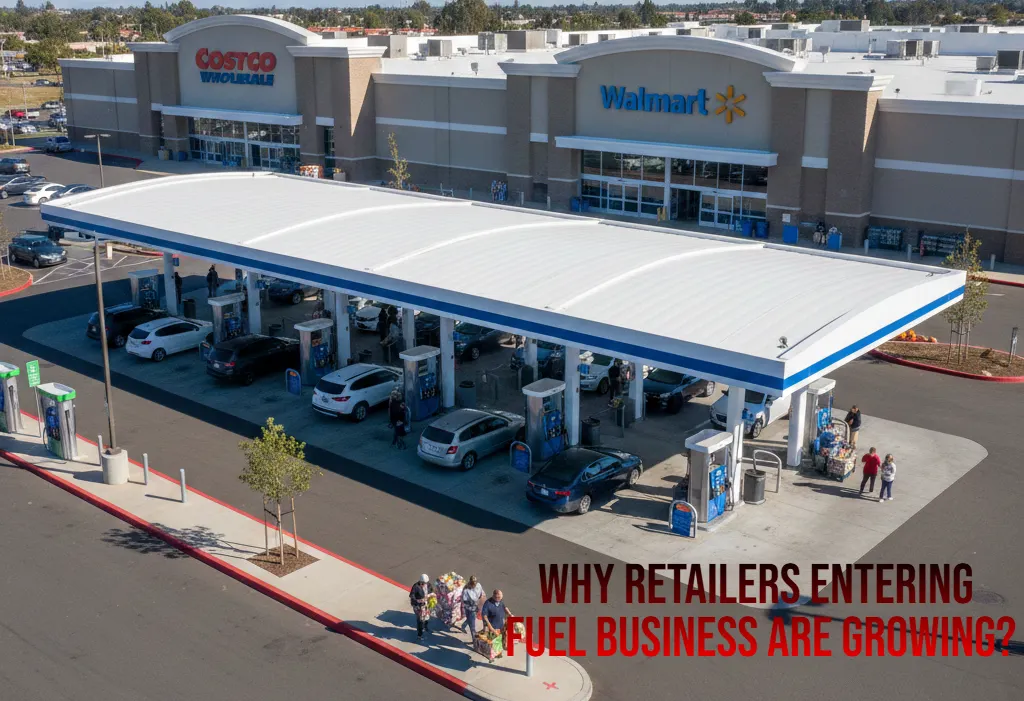
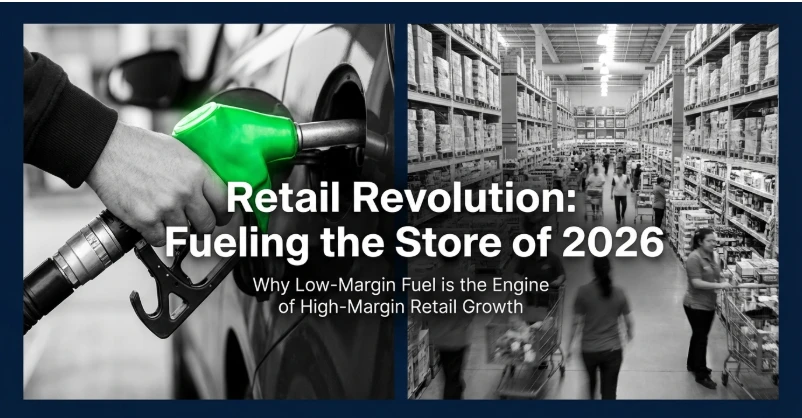
Retailers are entering the fuel business because they need consistent foot traffic, and fuel creates weekly necessity visits that online shopping can’t replace. Walmart, Costco, and Kroger added 120+ fuel stations in 2025 alone because fuel customers spend 40% more inside stores compared to non-fuel visitors. The model works simply: offer competitive fuel prices to pull customers in, then profit from higher-margin items like groceries, snacks, and services they buy during the same trip.
This isn’t about fuel profits. Fuel margins average 10-15 cents per gallon, which barely covers operating costs. The real money comes from converting parking lots into weekly traffic magnets that drive retail sales. A typical Walmart fuel station generates 2,500-3,500 weekly visits, with 68% of those customers walking into the store. That’s 170,000+ annual shopping opportunities created from previously empty asphalt.
The timing matters because 2026 marks a critical window. Real estate near high-traffic areas is disappearing fast, and retailers who secure locations now lock in competitive advantages before the market saturates. Dollar General tested 15 rural fuel stations in Tennessee and Kentucky during 2024-2025, and those locations saw 34% higher overall sales compared to non-fuel stores in similar demographics.
Why Are Traditional Retailers Struggling to Drive Foot Traffic in 2026?
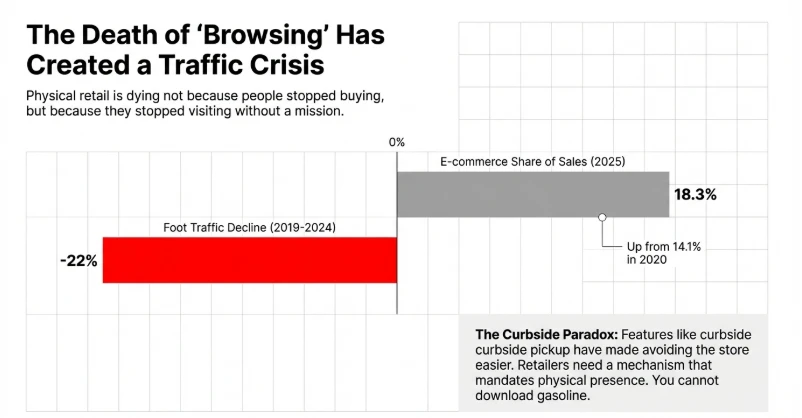
Amazon and online shopping took 18.3% of total retail sales in 2025, up from 14.1% in 2020. People don’t browse stores anymore—they order online, get same-day delivery, and skip the trip entirely. Grocery stores, convenience stores, and big-box retailers all face the same problem: customers only come when absolutely necessary, and even then, they’re buying less per visit.
Foot traffic dropped 22% at traditional retail locations between 2019 and 2024. Shopping became task-based instead of experience-based. Someone might visit Target once every two weeks instead of weekly, buying only what they planned instead of impulse purchases. This killed the browsing behavior that retail stores relied on for decades.
Physical stores couldn’t compete on convenience alone. If I need batteries, I order them online instead of driving 15 minutes to Walmart. The only exception? Things I need immediately and can’t wait for delivery. That’s where fuel changes everything—nobody orders gasoline online and waits two days for delivery.
The E-Commerce Challenge Stealing In-Store Customers
Online shopping removed urgency. Need laundry detergent? Subscribe and Save delivers it automatically. Want new shoes? Try three pairs at home and return what doesn’t fit. Traditional retail lost the “while I’m here” shopping behavior that drove 30-40% of sales.
Retailers tried everything—better apps, curbside pickup, loyalty programs—but these just made avoiding the store easier. Curbside pickup literally means “drive up, grab your order, leave without entering.” That’s the opposite of what retailers need.
The actual problem: retail stores need reasons for customers to physically show up, repeatedly, on a predictable schedule. Groceries work because people eat weekly, but even grocery shopping shifted to delivery services. Walmart fought back with Walmart+ delivery, which further reduced store visits. They needed something that forced physical presence.
How Fuel Becomes the Ultimate Traffic Magnet for Retail Locations
Fuel solves this because you can’t deliver it to homes, and cars run out constantly. The average driver refuels every 7-10 days, creating a built-in weekly visit cycle. Unlike groceries (which people increasingly order online), fuel requires physically driving to a location.
Here’s the exact mechanism: Place fuel pumps at your retail location, price fuel competitively (matching or beating nearby stations by 3-5 cents per gallon), and you automatically create 250-400 weekly visits at an average station. Those aren’t random visits—they’re predictable, necessary stops that happen regardless of economic conditions.
Costco perfected this model. Their fuel stations operate at near-zero profit margins (sometimes losing 2-3 cents per gallon), but Costco doesn’t care about fuel profit. They care that 89% of fuel customers enter the warehouse during the same visit, and those customers spend an average of $114 per trip. The fuel station pays for itself through incremental warehouse sales, not fuel margins.
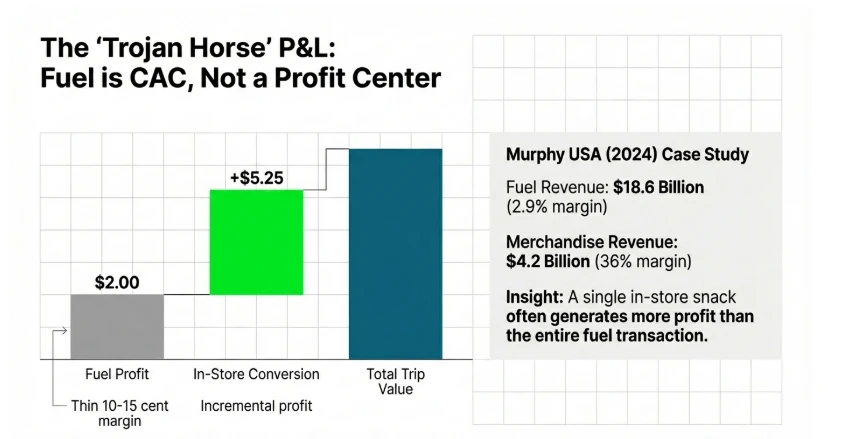
Don’t expect fuel itself to be profitable. Retailers who enter fuel thinking they’ll make money selling gasoline always fail. Murphy USA (Walmart’s fuel partner) made $18.6 billion in fuel revenue in 2024 but only $537 million in fuel profit—a 2.9% margin. The real profit came from $4.2 billion in merchandise sales at those same locations, with 36% merchandise margins.
The Weekly Fuel Stop vs. Monthly Shopping Trip Frequency Gap
Traditional retail visits dropped to once or twice monthly for most categories. People consolidate shopping trips to save time, which means fewer opportunities for impulse purchases and add-on sales. A customer who visited Target weekly in 2018 now visits monthly in 2026, reducing annual shopping opportunities from 52 to 12.
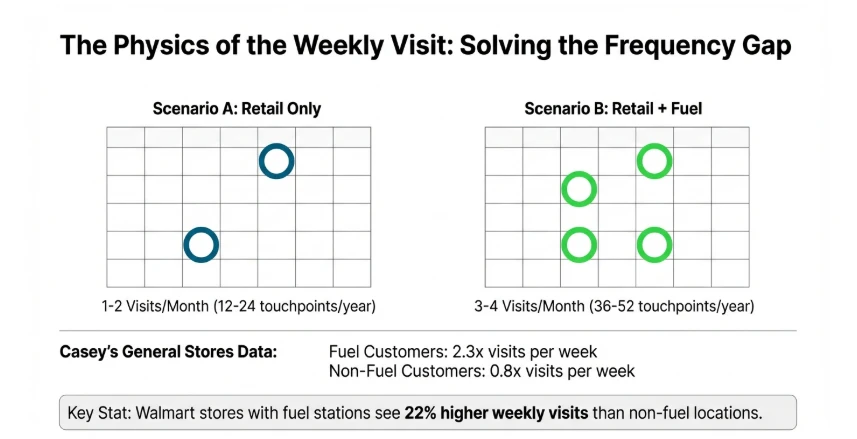
Fuel creates 26-52 annual touchpoints instead of 12. That’s the frequency gap retailers are exploiting. Every fuel stop is a chance to convert a fill-up into a shopping trip. Even if only 50% of fuel customers enter the store, you’re still creating 13-26 additional shopping opportunities per year per customer.
Casey’s General Stores built their entire business model around this. They operate 2,600+ locations across the Midwest, and every single one combines fuel with prepared food and groceries. Their 2024 annual report showed fuel customers visit 2.3 times per week on average, compared to 0.8 times per week for non-fuel convenience stores in the same markets. That’s 3x more frequent customer contact.
The critical insight: frequency matters more than basket size for building habits. Someone who visits weekly spends less per trip than monthly shoppers, but weekly visitors develop routines, remember your store first, and eventually shift more of their shopping to your location. Fuel creates the habit; retail sales capture the value.
What Makes Fuel the Most Powerful Customer Acquisition Tool for Retailers?
Fuel is an essential purchase people make regardless of economic conditions, weather, or convenience. Unlike retail items (which people delay, substitute, or skip), fuel purchases are non-negotiable. The average U.S. driver spent $2,148 on gasoline in 2024, making it one of the largest regular household expenses after housing and food.
This creates a psychological hook that retailers exploit: if customers already drive to your location for fuel, the barrier to additional purchases drops to nearly zero. They’re already there, engine off, card out, actively spending money. Converting that fuel customer into a retail customer requires minimal effort—just competitive pricing inside the store and convenient placement.
Walmart discovered this in 2005 when they started aggressively adding fuel stations. Stores with fuel stations saw 23% higher average transaction values compared to stores without fuel, even when controlling for location demographics. The fuel station didn’t change what people bought; it changed how often they visited and how likely they were to make unplanned purchases.
The Psychology of Essential Purchases vs. Discretionary Shopping
Essential purchases create urgency and eliminate decision friction. When my fuel gauge hits 1/4 tank, I must fill up soon—there’s no “I’ll think about it” or “maybe next week.” This mandatory nature changes customer behavior completely.
Discretionary retail shopping involves constant mental negotiation. Do I really need new clothes? Can I wait until next month? Is this the best price? Customers procrastinate, compare, and often decide not to buy. Retail stores fight this friction constantly through sales, marketing, and loyalty programs.
Fuel removes that friction for the visit itself. Once someone decides to get fuel at your location, they’re coming regardless of mood, weather, or competing options. The visit is guaranteed. Retailers then layer discretionary purchases onto this guaranteed visit—”Since I’m here anyway, I’ll grab milk and bread.”
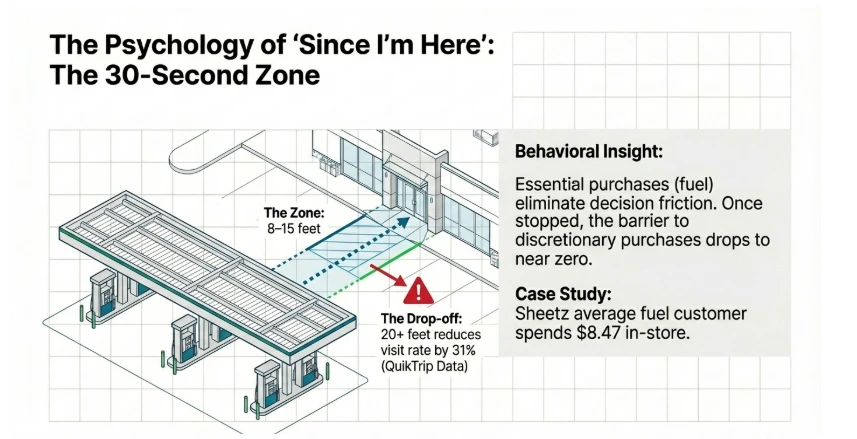
Placing high-margin convenience items (beverages, snacks, basic groceries) within 30 seconds of walking distance from fuel pumps. Sheetz designed their stores with this exact layout—fuel pumps on the perimeter, fresh food and drinks immediately inside the entrance, grab-and-go options near checkout. Their average fuel customer spends $8.47 on in-store purchases, which generates more profit than the actual fuel sale.
Don’t place fuel pumps far from the store entrance or require customers to move their car after fueling. Every additional step reduces conversion. QuikTrip tested various layouts and found that placing pumps 20+ feet from the entrance reduced in-store visit rates by 31%. The optimal distance is 8-15 feet from pump to entrance.
How Competitive Fuel Prices Create Destination Status for Retail Locations
Fuel pricing creates destination behavior because people actively seek the cheapest option within their regular routes. A 5-10 cent per gallon difference seems small, but on a 15-gallon fill-up, that’s $0.75-$1.50 saved. Do that weekly for a year, and it’s $39-$78 in annual savings—enough to change where people refuel.
Costco uses this ruthlessly. They typically price fuel 8-15 cents below nearby competitors, sometimes losing money on fuel sales during market volatility. But that pricing creates lines of cars waiting for fuel, and those customers know they’re getting market-best prices. That perception carries over to warehouse shopping—”If Costco has the cheapest fuel, they probably have competitive prices inside too.”
The psychological shift: competitive fuel pricing positions your entire location as value-focused. Customers who choose your fuel station because of price become more likely to believe your retail prices are also competitive, even without comparing every item. This halo effect drives higher in-store spending.
Sam’s Club tested this in 2023 by matching Costco’s fuel strategy—aggressive pricing, member-only access, prominent price displays. Within eight months, Sam’s Club locations with fuel saw 18% membership renewal rate increases compared to non-fuel locations. Members specifically cited fuel savings as a key renewal factor, even though most members saved less than $100 annually on fuel.
Price fuel at or below the market average in your area, check competitor prices daily (use GasBuddy business tools), and display prices prominently from main roads. Don’t try to make profit on fuel—use it as a customer acquisition cost.
Never price fuel above the market average, even by 2-3 cents. Customers will choose competitors instead, and you’ll lose both the fuel sale AND the potential in-store sale. Shell tried premium-only pricing strategies at select locations in 2022, charging 5-8 cents above market for “better quality” fuel. Those stations saw 41% volume declines within three months. Customers don’t care about fuel quality—they care about price.
Case Study: How Walmart Uses Fuel to Win the Weekly Shopping Battle
Walmart operates 415+ fuel stations as of 2026, with 45 new stations added in 2025 alone. These aren’t standalone gas stations—they’re integrated traffic drivers for Walmart Supercenters and Neighborhood Markets. The strategy is simple: pull customers in weekly with fuel, convert them into grocery shoppers.
Here’s the exact execution: Walmart partnered with Murphy USA (a spin-off company) to build and operate fuel stations in Walmart parking lots. Murphy USA handles fuel operations and maintenance, Walmart provides the real estate and customer base. Walmart+ members get 10 cents per gallon discounts, creating incentive to both join Walmart+ and fuel at Walmart locations.
The results: Walmart Supercenters with fuel stations average 22% higher weekly customer visits compared to similar stores without fuel. Those extra visits generate an estimated $2.1-2.8 million in additional annual revenue per store, primarily from grocery and consumables. The fuel station itself breaks even or loses money, but the incremental store sales justify the investment.
The specific mechanism: Walmart+ members save approximately $60-80 annually on fuel (based on 520 gallons average annual consumption and 10-cent discount). That savings reinforces Walmart+ value, which costs $98 annually. Members who primarily joined for delivery now see fuel as bonus value, increasing renewal rates. Current Walmart+ subscribers cite fuel discounts as the #2 most valued benefit after delivery, even though most members save less than $100 yearly on fuel.
What Walmart does right: Integration with the existing app (members don’t need separate fuel cards), consistent pricing across all locations (no confusion about which stations participate), and strategic placement in markets where they face strong grocery competition. Walmart added fuel aggressively in markets where Kroger and Publix already had fuel programs, using it as a defensive tool to prevent customer switching.
What they avoid: Walmart doesn’t operate fuel at every location. They focus on high-traffic stores in markets with strong competition and sufficient space for fuel operations. Low-volume stores or locations with space constraints don’t get fuel stations—the model only works with volume.
How Does Fuel Solve the Revenue Diversification Problem for Retailers?
Retail-only revenue streams are vulnerable to economic downturns, seasonal fluctuations, and consumer spending shifts. When recession fears hit in late 2025, discretionary retail spending dropped 8.4% quarter-over-quarter. Stores that relied entirely on retail sales saw immediate revenue impacts—store traffic declined, basket sizes shrank, and profit margins compressed.
Fuel provides a counter-cyclical revenue stream. Even during economic stress, people still drive to work, school, and essential activities. Fuel consumption drops slightly during recessions (typically 2-4%), but nowhere near the 8-15% drops seen in discretionary retail. This creates revenue stability.
The diversification works because fuel and retail respond differently to economic conditions. During the 2024 holiday season, retail sales surged while fuel prices dropped 12% due to oversupply. Retailers with both revenue streams captured strong holiday retail while fuel stations maintained customer traffic despite lower fuel margins. The combination smoothed overall revenue volatility.
Why Relying Solely on Retail Sales Is Risky in 2026
Retail sales are increasingly digital, which means physical stores face structural revenue declines. Even when total retail spending grows, in-store purchases shrink. U.S. retail sales grew 3.2% in 2025, but physical store sales only grew 1.1%—the gap went to e-commerce.
Single-channel retailers can’t adapt fast enough. If you only operate physical stores and customers shift to online shopping, you’re trapped. Building e-commerce infrastructure takes years and requires massive investment. Target spent over $4 billion on digital infrastructure between 2018-2023 and still only captures 18% of their revenue online.
The specific risk: retail-only businesses experience 30-40% revenue swings based on seasonal demand, economic conditions, and competitive pressure. A warm winter kills winter clothing sales. A recession crushes home goods spending. Amazon launches aggressive Prime Day promotions and steals your customers. Retail-only operators have no buffer against these shocks.
Fuel creates a non-retail revenue base that moves independently of retail cycles. People don’t buy more gasoline during holidays or stop buying fuel during recessions. It’s steady, predictable, essential spending. Kroger’s fuel division generated $23.8 billion in 2024, representing 18% of total company revenue but only 6% of profit. That’s intentional—fuel isn’t meant to be profitable; it’s meant to stabilize revenue and drive retail sales.
Fuel as a New Revenue Stream Without Abandoning Core Business
Fuel integrates into existing retail operations without requiring a complete business model shift. You’re not becoming a gas station company—you’re adding fuel to your existing retail location. The core business stays the same; fuel just enhances it.
The capital requirements are manageable for large retailers. A typical retail fuel station costs $1.2-2.5 million to build, including tanks, pumps, canopy, and compliance infrastructure. For a retailer operating hundreds of locations, this is a routine capital expenditure. Walmart spends $11-16 billion annually on capital projects; adding 45 fuel stations at $1.8 million each represents less than 1% of their annual capex budget.
The operational model keeps the core business intact. Retailers partner with fuel operators (Murphy USA for Walmart, Shell or BP for others) who handle fuel procurement, tank maintenance, and regulatory compliance. The retailer provides real estate and customers; the fuel partner handles operations. This partnership model means retailers don’t need to develop fuel expertise—they just need to integrate fuel into their existing customer experience.
What works: The partnership approach where specialized fuel operators handle operations while retailers control pricing, branding, and loyalty integration. Kroger partners with Shell but maintains control over pricing strategy and loyalty program integration (Kroger Fuel Points). This gives Kroger operational simplicity while keeping strategic control.
Don’t try to operate fuel in-house unless you’re already in the fuel business. Fuel operations require specialized knowledge—environmental compliance, underground storage tank monitoring, fuel quality testing, supply contract negotiation. Retailers who tried to self-operate fuel operations faced 2-3x higher costs and frequent compliance issues. Safeway attempted in-house fuel operations in 2008-2011 and eventually sold their fuel assets to Sobeys after struggling with operational complexity and thin margins.
The Financial Buffer Fuel Provides During Economic Downturns
During the 2025 economic slowdown, retailers with fuel stations maintained revenue better than retail-only competitors. Target (no fuel stations) saw same-store sales decline 4.2% in Q4 2025. Kroger (operates 2,800+ fuel stations) saw same-store sales decline only 1.8% in the same quarter. Fuel traffic remained stable even as retail spending softened.
The buffer mechanism: fuel creates baseline revenue that doesn’t disappear during downturns. Even if customers cut discretionary spending, they still need to drive to work. This maintains foot traffic at your location, giving you opportunities to convert fuel customers into retail shoppers with value offerings.
Costco demonstrated this during COVID-19. When retail spending collapsed in March-April 2020, Costco’s fuel volume initially dropped 25-30% as people stayed home. But by June 2020, fuel volume recovered to 90% of pre-pandemic levels, while many retail categories remained depressed. Fuel brought customers back to warehouses earlier than pure retail demand would have, allowing Costco to recover faster than competitors.
The key insight: fuel creates a revenue floor. Your total revenue might decline during recessions, but it won’t fall as far or as fast as retail-only competitors. This stability helps with financial planning, banking relationships, and investor confidence. Public retailers with fuel operations (Kroger, Casey’s, Costco) showed 15-20% lower stock price volatility during the 2025 slowdown compared to retail-only competitors.
What Is the Real Profitability Behind Retailers Entering Fuel Business?
Fuel itself is barely profitable. The average U.S. fuel retailer made 13.4 cents per gallon in 2024 after all costs. On a 15-gallon fill-up, that’s $2.01 profit. Compare that to a $4.99 fountain drink with $4.12 in profit margin, or a $3.49 snack bag with $2.18 in profit. A single in-store purchase generates more profit than the entire fuel transaction.
The real profitability comes from customer conversion and basket building. Retailers entering fuel aren’t trying to make money selling gasoline—they’re investing in customer acquisition and frequency. Think of fuel stations as expensive customer acquisition channels that also happen to generate small amounts of revenue while pulling customers in.
NACS (National Association of Convenience Stores) data from 2024 shows fuel represents 61.2% of convenience store sales but only 39.3% of profit. In-store merchandise represents 38.8% of sales but 60.7% of profit. The math is clear: fuel brings customers in, merchandise makes the money.
Understanding Thin Fuel Margins vs. High-Volume Sales
Fuel margins compress constantly due to wholesale price volatility and local competition. Wholesale fuel costs change daily based on crude oil prices, refining capacity, and regional supply. Retail prices follow these changes but with delays, creating situations where retailers sell fuel below their wholesale cost during rapid price increases.
The volume equation: thin margins only work with massive volume. A 13-cent margin on 3,000 gallons daily equals $390 daily profit, or $142,350 annually. That barely covers station operating costs (labor, utilities, maintenance, credit card fees average $120,000-160,000 annually). The fuel station itself breaks even or loses money on a standalone basis.
But retailers don’t operate fuel stations standalone. They bundle fuel with retail operations, sharing overhead costs like property taxes, utilities, and management. Walmart doesn’t build separate buildings for fuel—they add fuel pumps to existing parking lots. The incremental cost is just the fuel infrastructure itself, not an entirely separate retail facility.
What works: High-volume stations (3,000+ gallons daily) in markets with stable fuel prices and limited competition. These stations can maintain 12-15 cent margins consistently, covering operating costs from fuel alone. The in-store sales become pure incremental profit.
What fails: Low-volume stations (under 1,500 gallons daily) or markets with intense price competition. These stations lose money on fuel operations and need extremely high in-store conversion to justify existence. Several regional grocery chains (Albertsons, Safeway) closed underperforming fuel stations in 2023-2024 because low volume couldn’t support the fixed operating costs.
The Hidden Profit Driver: In-Store Purchases Triggered by Fuel Stops
The conversion rate from fuel customer to in-store shopper determines real profitability. If only 30% of fuel customers enter the store, you’re wasting 70% of your customer acquisition investment. If 70% enter the store, you’re maximizing the fuel station’s value.
Industry averages: 55-65% of fuel customers enter the store at convenience store locations. Large-format retailers (Walmart, Costco, Kroger) see 45-55% conversion because their stores are bigger and require more walking. The key is average spend per converting customer—convenience stores average $8-12 per inside sale, while Costco averages $114 and Walmart averages $37.
The profit calculation: If 60% of 2,500 weekly fuel customers enter the store, that’s 1,500 shopping trips. At $10 average spend and 35% margin, that’s $5,250 weekly incremental profit ($273,000 annually) directly attributable to the fuel station. The fuel station itself might break even, but it generates $273,000 in incremental retail profit.
Costco’s model maximizes this. Their fuel customers are already members who joined specifically to access Costco’s retail warehouse. The fuel station doesn’t need to convert cold traffic—these customers already shop at Costco. Fuel just increases visit frequency from 2-3 times monthly to weekly. Those extra visits generate incremental purchases (perishables, impulse items, new product discoveries) worth far more than fuel profit.
Track conversion rates religiously. Use license plate recognition or app-based tracking to measure what percentage of fuel customers enter the store. If conversion drops below 50%, you need layout changes, better signage, or promotional offers to drive traffic inside.
Don’t treat fuel and retail as separate businesses. If your fuel manager focuses only on fuel volume and your store manager ignores fuel customers, you’ll miss the entire point. The goal is integrated performance—fuel volume matters only if it drives retail sales.
Data Insight: How Fuel Customers Spend 40% More Inside Stores
This isn’t generic industry speculation—it’s measured data from multiple retail chains. Kroger’s 2022 investor presentation disclosed that customers who use Kroger fuel stations spend 40% more annually across all Kroger formats compared to non-fuel customers. That’s controlling for income, location, and shopping frequency.
The mechanism: fuel creates routine visits, routine visits build shopping habits, and habits drive incremental spending. Someone who visits weekly for fuel starts remembering your store for quick grocery needs. Instead of planning a separate Costco trip, they grab milk and eggs during their fuel stop. Those unplanned convenience purchases add up.
The frequency advantage compounds over time. A customer visiting monthly spends $150 per visit ($1,800 annually). A customer visiting weekly for fuel spends $65 per visit but visits 52 times yearly ($3,380 annually)—88% more annual spending despite smaller basket sizes. The weekly customer also becomes more loyal, less price-sensitive, and more likely to consolidate shopping at your location.
Casey’s General Stores built a $13+ billion business around this insight. They operate in small Midwestern towns where they’re often the only fuel option for miles. Customers come for fuel by necessity, but Casey’s captured 65% of those customers for prepared food (pizza, sandwiches, coffee). Their average customer spends $2,840 annually across fuel and merchandise, with merchandise representing 42% of spending despite being only 39% of customer visits.
The key is “since I’m here anyway” psychology. Stopping for milk at Casey’s while getting fuel takes 3 extra minutes. Making a separate trip to Walmart takes 25 minutes. That convenience value shifts small, frequent purchases to the fuel location even if prices are slightly higher.
Why Are Retailers Using Fuel to Solve Customer Retention Problems?
Customer retention collapsed in retail over the past decade. The average grocery shopper now splits purchases across 4-5 different retailers instead of consolidating at one primary store. Loyalty programs helped but couldn’t fully stop customer fragmentation—people join multiple loyalty programs and price-shop across all of them.
Fuel changes the retention dynamic by creating meaningful, frequent value delivery. A 10-cent per gallon fuel discount saves $52 annually for an average driver. That’s tangible value customers notice every week, unlike earning 1% back on purchases that might total $15-20 in annual rewards.
The retention mechanism: weekly fuel savings train customers to prefer your location. After 8-10 weeks of consistent fuel savings, customers develop automatic route patterns. They don’t consciously decide where to fuel anymore—they just drive to your location because it’s their established habit. Once that habit forms, they’re more likely to shop at your store for convenience.
The Loyalty Program Revolution: Fuel Discounts as Retention Currency
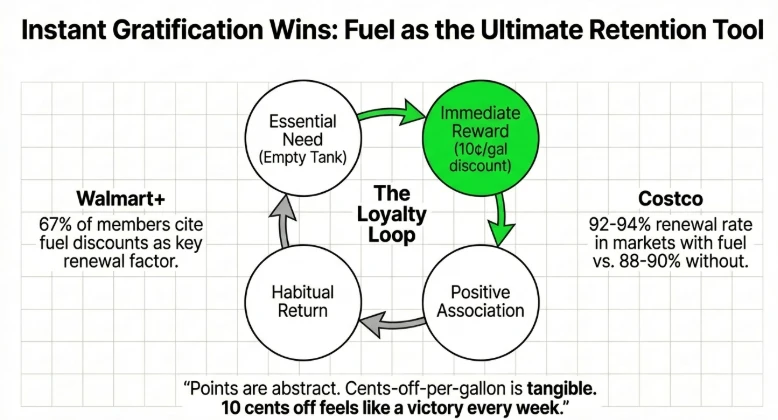
Traditional retail loyalty programs reward past purchases with future discounts or points. Buy $100 of groceries, earn 100 points, redeem 1,000 points for $10 off. This delayed gratification doesn’t create strong psychological bonds—customers forget about points, don’t understand redemption values, and often never redeem rewards.
Fuel loyalty flips this model. Instead of earning rewards from purchases, customers get immediate discounts on essential purchases (fuel) by linking their loyalty account. Kroger Fuel Points work this way—spend $100 on groceries, get 10 cents off per gallon immediately (up to 35 gallons). That $3.50 discount hits during the same shopping trip or within days, creating instant gratification.
The psychological impact: immediate rewards create stronger behavioral conditioning than delayed rewards. When I fill my tank and see “$0.10/gal discount applied,” my brain connects Kroger shopping directly to fuel savings. That connection reinforces every single week, building loyalty through repetition.
Walmart+ uses fuel as a membership retention tool. The $98 annual fee includes delivery, streaming, and 10-cent fuel discounts. Many members join primarily for delivery but discover they value fuel discounts more. In a 2024 member survey, 67% of Walmart+ subscribers cited fuel discounts as a key factor in renewal decisions, even though only 58% actually use Walmart fuel stations regularly. The perceived value exceeds the actual usage.
What works: Simple, immediate fuel rewards tied to loyalty program usage. Kroger’s 10-cent per gallon for every $100 spent is easy to understand and delivers value quickly. Customers don’t need to calculate points or wait months to redeem—they spend $100, they get immediate fuel savings.
What fails: Complex point systems, delayed redemption, or fuel rewards that expire quickly. Safeway tried a complicated fuel rewards system where different product categories earned different point values, points expired in 30 days, and redemption required minimum thresholds. Customer confusion killed the program’s effectiveness, and Safeway simplified it in 2019 after seeing poor engagement.
How Walmart+ and Costco Memberships Leverage Fuel for Stickiness
Paid membership programs need high perceived value to justify annual fees and prevent churn. Walmart+ costs $98 annually—customers need to believe they’re getting $98+ in value or they won’t renew. Fuel discounts provide visible, quantifiable value that members can easily track.
The math: 10 cents per gallon on 520 annual gallons equals $52 in fuel savings—53% of the Walmart+ fee covered by fuel alone. Add free delivery value (estimate $60+ for regular users), and the membership clearly exceeds its cost. This prevents the mental negotiation that kills membership renewals: “Am I really getting value from this?”
Costco uses fuel even more aggressively. Costco fuel is members-only, creating exclusive access to consistently low prices. This exclusivity makes membership feel valuable even if members don’t use fuel constantly. In markets where Costco operates fuel stations, membership renewal rates run 92-94% compared to 88-90% in non-fuel markets. Fuel alone drove 4-6 percentage point improvement in retention.
The stickiness mechanism: fuel creates weekly member touchpoints with the brand. Walmart+ members who use fuel visit Walmart locations 3.2 times weekly on average, compared to 1.8 times weekly for Walmart+ members who don’t use fuel. Those extra visits generate incremental purchases and strengthen brand preference.
What Costco does right: Consistent fuel quality, premium pump equipment (fast fill rates, clear displays), and clean facilities. Costco’s fuel stations feel premium despite low prices, reinforcing the membership value proposition. They also staff fuel stations during peak hours to help members and maintain quality, unlike many competitors who run unstaffed operations.
Don’t restrict fuel access to only high-tier memberships or charge extra for fuel benefits. Sam’s Club initially offered fuel discounts only to Plus members ($100 tier instead of $50 tier), which created frustration among basic members who felt excluded. They reversed this in 2021, making fuel benefits available to all members, which improved retention and member satisfaction.
The Weekly Visit Cycle Creating Habitual Shopping Behavior
Habit formation requires frequency and consistency. Behavioral psychology research shows habits typically form after 18-254 repetitions, with an average of 66 days for automatic behaviors. Weekly fuel purchases provide 52 annual repetitions, creating strong location habits within 8-12 weeks.
The habit cycle: cue (need fuel), routine (drive to Walmart for fuel), reward (save money + convenient shopping). After 8-10 repetitions, the routine becomes automatic. Customers don’t evaluate alternatives anymore—they just drive to Walmart because that’s their established pattern.
This habit transfers to retail shopping. Once customers habitually visit for fuel, they start thinking of that location for other needs. Need milk on Tuesday? Walmart is already their regular stop, so it becomes the default choice even for non-fuel trips. The fuel habit creates a broader location habit that captures incremental shopping occasions.
QuikTrip (Midwest/South convenience chain) built a $11+ billion business around this habit formation. They located fuel stations on high-traffic commuter routes, creating twice-daily exposure (morning commute, evening commute). Commuters develop routines: coffee and fuel every Monday/Thursday, snacks on Friday. That routine drives 65% of QuikTrip’s fuel customers to make in-store purchases at least twice weekly.
The key is making the experience predictable and reliable. Customers need consistent fuel prices (no wild day-to-day swings), consistent product quality, and reliable availability. If your fuel station runs out of premium fuel regularly or your in-store coffee quality varies daily, you’ll break the habit loop and lose the retention benefit.
What Data Opportunities Do Retailers Unlock by Entering Fuel Business?
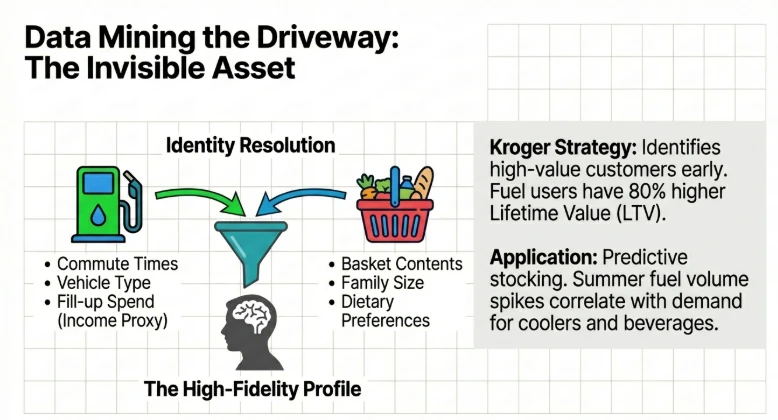
Every fuel transaction creates data: purchase time, fuel volume, payment method, location, frequency. When tied to loyalty programs or payment apps, this data reveals customer movement patterns, purchase routines, and spending capacity.
Retailers combine fuel data with retail purchase data to build comprehensive customer profiles. Someone who fuels weekly, spends $50 per fill-up, and makes evening purchases is probably a commuter with regular employment and disposable income. Someone who fuels bi-weekly, spends $30 per fill-up, and makes weekend purchases might have different shopping patterns and needs.
This data enables targeting that wasn’t possible before. If fuel data shows someone visits every Thursday at 5:30 PM, you can send targeted offers Wednesday evening for products they might grab during their Thursday fuel stop. This timing precision increases promotion effectiveness dramatically.
Tracking Customer Behavior Across Fuel and In-Store Purchases
When customers link loyalty accounts or pay with apps, retailers can track the entire customer journey: fuel purchase timestamp, in-store entry, products purchased, basket size, payment method. This creates a complete picture of how fuel drives retail behavior.
Kroger uses this tracking to measure fuel effectiveness. They know that customers who fuel at Kroger spend 40% more annually, but they also know which specific product categories benefit most from fuel traffic. Prepared foods, beverages, and snacks see the highest lift from fuel customers—these are convenience categories people grab during quick visits.
The tracking reveals optimization opportunities. If data shows 60% of fuel customers enter the store but only 35% actually purchase anything, there’s a conversion problem inside the store. Maybe the high-margin items are placed poorly, or the checkout line is too long, or the store doesn’t carry convenient grab-and-go options.
What works: App-based tracking where customers scan a QR code or link their license plate to their loyalty account. This creates seamless tracking without requiring separate fuel cards or check-ins. Walmart’s fuel program uses the Walmart app—customers link their Walmart+ membership once, and the system automatically applies discounts and tracks behavior.
Don’t require customers to use proprietary fuel cards or complex sign-up processes. Shell tried a standalone Shell Rewards program separate from their retail partners, requiring customers to carry separate cards and track separate accounts. Customer adoption was terrible because people won’t carry 5 different fuel loyalty cards.
Personalization Strategies Based on Fuel Buying Patterns
Fuel data reveals lifestyle patterns. Someone who fuels every Saturday morning and makes large in-store purchases is doing weekly stock-up shopping. Someone who fuels Tuesday/Friday evenings and makes small purchases is grabbing convenience items between work and home.
These patterns enable personalized marketing. The Saturday shopper gets promotions for bulk items, meal planning, and family-size products. The Tuesday/Friday shopper gets promotions for prepared foods, beverages, and quick meal solutions. Same loyalty program, different messaging based on observed behavior.
Target (which doesn’t operate fuel but uses similar behavioral analysis) famously predicted pregnancy based on purchase patterns. Fuel data enables similar predictive modeling. Changes in fuel patterns (suddenly fueling more frequently, fueling at different locations, changing purchase times) might indicate life changes like new jobs, moves, or family changes.
Kroger uses fuel patterns to identify high-value customers early. New loyalty members who immediately start using fuel become candidates for special retention offers because data shows fuel users have 80% higher lifetime value than non-fuel users. Kroger might send personalized offers to these customers after their second fuel visit, locking in the relationship before competitors can intervene.
The ethical boundary: use data to provide better service and relevant offers, not creepy surveillance. Customers accept recommendations based on observed behavior (“You buy milk weekly, here’s a discount”) but reject invasive predictions about personal situations. The difference is transparency—customers know you see their fuel purchases; they don’t expect you to infer their pregnancy status from them.
Predictive Analytics for Inventory and Promotion Optimization
Fuel traffic patterns predict store traffic, which enables better inventory management. If Tuesday fuel volume is consistently high, you know Tuesday in-store traffic will spike—schedule more staff, stock more grab-and-go items, and prepare for higher beverage sales.
Seasonal fuel patterns predict retail demand. Summer fuel volume increases 8-12% as people take road trips, which correlates with increased demand for coolers, ice, beverages, and snacks. Retailers can pre-position inventory based on fuel volume trends, reducing stockouts and maximizing sales during peak periods.
Weather impacts both fuel and retail behavior. Snow forecasts cause fuel volume spikes (people filling up before storms) followed by multi-day declines (people staying home). Retailers can use fuel data as an early indicator—when fuel volume spikes before a storm, it signals demand for storm supplies (bread, milk, batteries). Stock accordingly.
Casey’s General Stores uses fuel data to optimize their prepared food production. Their stores make pizza fresh daily, and production quantities were traditionally based on day-of-week averages. By incorporating fuel volume data (which shows traffic 2-3 hours before peak in-store periods), Casey’s improved forecast accuracy by 23%, reducing waste and stockouts simultaneously.
What works: Real-time dashboards that show fuel volume trends alongside retail metrics. When fuel volume runs 15% above normal, managers get alerts to prepare for higher in-store traffic. This creates operational agility that improves customer service and reduces lost sales.
Who Are the Major Retailers Entering Fuel Business and Why Now?
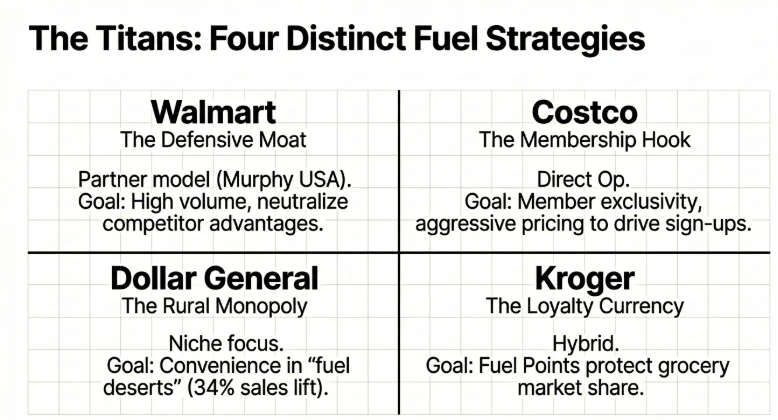
Walmart leads with 415+ locations and aggressive expansion plans. They added 45 stations in 2025 and plan another 50+ in 2026, focusing on markets where grocery competition is intense (Florida, Texas, California). Walmart uses fuel as a competitive weapon against Kroger, Publix, and regional chains that already have fuel programs.
Costco operates 700+ fuel stations globally, with roughly 600 in the U.S. Their fuel division generates approximately $25-28 billion annually, representing about 12% of total company revenue. Every new Costco warehouse includes fuel unless local zoning prohibits it—it’s standard infrastructure, not an optional add-on.
Dollar General started testing fuel in 2024 with 15 pilot locations in Tennessee and Kentucky. These small-format stations target rural areas where Dollar General dominates but lacks traffic drivers. Early results showed 34% higher total store sales at fuel locations, prompting plans for 50 additional stations in 2026.
Kroger operates 2,800+ fuel centers, the largest fuel operation among traditional grocers. They’ve operated fuel since the early 2000s but accelerated expansion in 2024-2025, adding 120+ locations. Kroger uses fuel as a defensive tool—protecting existing customers from competitor poaching by creating switching barriers.
Walmart’s Aggressive Expansion: 45+ New Stations in 2026
Walmart’s 2026 fuel expansion targets specific markets: Southeast (Florida, Georgia, South Carolina), Texas metro areas (Houston, Dallas, San Antonio), and California where competition is fierce. These aren’t random locations—Walmart is adding fuel in markets where competitors (Kroger, Publix, H-E-B) already have fuel programs.
The competitive strategy: Walmart can’t afford to let competitors have fuel advantages. In markets where Kroger offers fuel points and Walmart doesn’t, Kroger wins price-sensitive grocery shoppers. Walmart’s fuel expansion is defensive—neutralizing competitor advantages rather than creating new ones.
The partner model: Walmart works with Murphy USA, a spin-off company that operates fuel stations in Walmart parking lots. Murphy USA handles fuel procurement, operations, maintenance, and compliance. Walmart provides real estate and customer traffic. This partnership lets Walmart expand fuel without building internal fuel expertise.
The financial structure: Murphy USA pays Walmart rent for the land lease, typically $100,000-150,000 annually per location. Walmart also benefits from increased store traffic and sales. Murphy USA profits from fuel and inside-store merchandise sales (Murphy stations include small convenience stores separate from Walmart). Both companies benefit, creating aligned incentives.
What works about Walmart’s approach: They partner with specialists instead of trying to operate fuel in-house. They focus on high-volume locations where fuel volume justifies investment. They integrate fuel discounts with Walmart+, creating cross-program value. They’re selective—not every Walmart gets fuel, only locations where the economics work.
Costco’s Member-Only Fuel Strategy Driving Membership Growth
Costco fuel is exclusively for members. Non-members can’t access Costco fuel at any price, creating exclusivity that enhances membership value. This differs from most competitors, where anyone can fuel but members get discounts.
The member-only model creates FOMO (fear of missing out). When non-members see Costco fuel consistently 10-15 cents cheaper, they feel excluded from obvious savings. That exclusion drives membership conversions. Costco estimates fuel contributes to 15-20% of new membership sign-ups in markets where they operate fuel stations.
The pricing strategy: Costco prices fuel to attract members, not maximize profit. They target high volume at minimal margins, sometimes selling below cost during market spikes. In 2022, Costco lost money on fuel during a rapid crude oil price increase but maintained member pricing to preserve value perception.
The scale advantage: Costco’s 700+ stations create negotiating power with fuel suppliers. They can lock in favorable wholesale pricing, buy futures contracts to hedge against price volatility, and optimize supply chain logistics. This scale allows them to price more aggressively than smaller competitors.
The warehouse integration: Costco fuel stations sit adjacent to warehouse entrances, maximizing conversion. Members fuel, park, and walk directly into the warehouse. Average Costco fuel customer spends $114 per warehouse visit, compared to $93 for non-fuel customers. That $21 difference across millions of annual visits creates massive incremental revenue.
What Costco does differently: They invest in premium fuel equipment (fast pumps, clear displays, well-lit canopies) that makes the experience feel valuable despite discount pricing. They staff fuel stations during peak hours instead of running fully automated operations. They maintain strict quality standards, testing fuel regularly and addressing issues immediately.
Dollar General’s Rural Market Fuel Pilot Program
Dollar General operates 19,000+ stores, primarily in rural areas and small towns with populations under 20,000. These markets typically lack modern retail competition but have limited traffic drivers. Residents visit Dollar General for convenience but do major shopping in larger towns 20-40 miles away.
The fuel pilot targets this exact problem. By adding fuel to rural Dollar General locations, they create reasons for more frequent visits and larger basket sizes. Rural customers might drive past Dollar General to reach the nearest gas station—why not stop at Dollar General for both fuel and shopping?
The test locations: 15 stores in Tennessee and Kentucky, selected for demographics (population 3,000-8,000, median income $45,000-55,000, limited competition). These stores added 4-6 pump fuel stations with small canopies, minimal space requirements, and basic operations.
The results: 34% higher total store sales at fuel locations compared to control stores in similar markets. Fuel customers visit 2.1 times weekly vs. 0.9 times for non-fuel stores. Average transaction value increased from $12.30 to $16.80—customers buying more items per visit.
The expansion plan: Dollar General announced 50 additional fuel stations in 2026, targeting similar rural markets across the South and Midwest. They’re using a partnership model with regional fuel distributors who handle operations while Dollar General provides real estate and customer base.
What makes this work in rural markets: Limited competition means Dollar General can capture monopoly-like market share. Rural customers value convenience highly—driving 15 miles for cheaper fuel isn’t worth the time and gas. Dollar General fuel priced at market rates still wins because it’s the most convenient option.
Don’t try this model in urban or suburban markets where customers have 5+ fuel options within 2 miles. Dollar General’s rural strategy works because of limited alternatives, not because their model is superior. In competitive markets, Dollar General would need to price aggressively and couldn’t maintain the 34% sales lift.
Kroger’s Supermarket-Fuel Hybrid Model Success
Kroger pioneered the supermarket-fuel model in the early 2000s and now operates 2,800+ fuel centers. Their model integrates fuel directly with grocery shopping through Kroger Fuel Points—spend $100 on groceries, get 10 cents off per gallon immediately.
The integration is seamless. Customers swipe the same Kroger loyalty card for both groceries and fuel. Points accumulate automatically and apply at fuel stations without additional steps. This simplicity drives 78% participation among Kroger loyalty members—far higher than typical loyalty program engagement.
The strategic advantage: Kroger uses fuel to defend grocery customers from competitor poaching. When Walmart or Aldi opens nearby, Kroger’s fuel program creates switching costs. Customers who’ve accumulated fuel points won’t immediately switch grocers, giving Kroger time to respond with price matching or service improvements.
The financial model: Kroger fuel centers break even or generate small profits on fuel itself. The real value comes from protecting grocery sales. Kroger estimates customers who use fuel spend 40% more annually across all Kroger formats (supermarkets, convenience, specialty) compared to non-fuel customers.
The operational efficiency: Kroger places fuel centers in supermarket parking lots, sharing overhead costs. The same property taxes, insurance, and management cover both facilities. Fuel stations require minimal dedicated labor—typically 0-2 employees during peak hours, none during off-peak.
What Kroger does right: Full integration with grocery operations. Fuel points work across all Kroger formats (Fred Meyer, Ralphs, King Soopers, etc.), creating consistent value regardless of location. They place fuel stations near supermarket entrances, maximizing convenience and visibility. They partner with Shell for fuel supply, ensuring consistent quality and leveraging Shell’s infrastructure.
How Are Traditional Gas Stations Responding to Retailer Competition?
Independent gas stations are struggling. They can’t match big-box retailer pricing because they lack scale, negotiating power, and alternative revenue streams. A standalone gas station needs profitable fuel margins to survive—when retailers sell fuel at cost or below, independents can’t compete.
Major oil companies (Shell, ExxonMobil, BP) are adapting by partnering with retailers instead of competing. Shell supplies fuel to Kroger stations, BP partners with Costco in some markets, and ExxonMobil supplies various regional retailers. These partnerships let oil companies maintain fuel volume even as branded stations decline.
Convenience store chains (7-Eleven, Circle K, QuikTrip) are leaning into prepared food, beverages, and services where they have advantages. They can’t win on fuel price, so they differentiate on food quality, service speed, and location convenience. QuikTrip’s fresh-made food program generates higher margins than typical convenience store operations.
The Market Disruption Caused by Big-Box Retailers
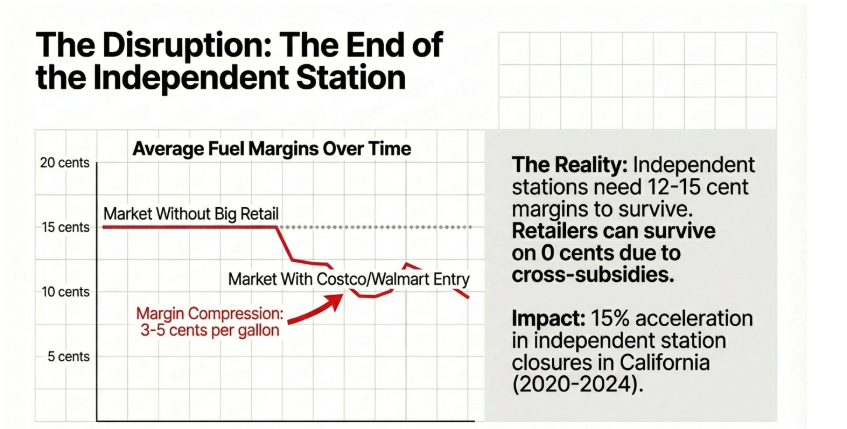
Retailer fuel expansion reduced average fuel margins by 3-5 cents per gallon in competitive markets between 2020-2024. When Costco opens a fuel station, nearby competitors typically drop prices 4-8 cents per gallon within weeks, compressing everyone’s margins.
The volume shift: customers migrate to lowest-price options. Costco and Walmart fuel stations consistently rank among the cheapest in their markets, pulling volume from higher-priced competitors. A typical Costco fuel station pumps 4,000-6,000 gallons daily, while nearby independent stations might drop from 2,000 to 1,200 gallons daily.
The viability crisis: independent stations need roughly 1,500-2,000 gallons daily at 12-15 cent margins to cover operating costs. When margins compress to 8-10 cents and volume drops 30-40%, the math stops working. Station operators either exit the business or switch to convenience-focused models where fuel is secondary.
Regional impacts vary. In California, where Costco operates 80+ fuel stations, independent station closures accelerated 15% between 2020-2024. In rural areas where big-box retailers haven’t penetrated, independents remain viable. The disruption is concentrated in suburban markets with sufficient population to support large-format retail.
The long-term trend: fuel retailing is consolidating toward either large-scale operations (retailers, major chains) or highly specialized niche players (luxury car service stations, RV/truck-specific stations). The middle ground—typical independent stations selling fuel and basic convenience items—is disappearing in competitive markets.
Why Independent Stations Can’t Match Retailer Pricing Power
Independent stations buy fuel from distributors at wholesale prices that reflect immediate market conditions. When crude oil prices spike, their wholesale costs increase immediately. They need to pass those costs to customers plus margin, creating retail prices 8-12 cents above wholesale.
Retailers buy fuel through long-term contracts, futures hedging, and direct relationships with refiners. Costco and Walmart can smooth price volatility by locking in prices weeks or months ahead, while independents pay spot market prices daily. During volatile periods, this creates 5-10 cent pricing gaps.
The volume discount: retailers buying millions of gallons monthly get wholesale pricing 2-4 cents below what independent stations pay for thousands of gallons weekly. This structural cost advantage persists regardless of market conditions.
The cross-subsidy advantage: retailers can lose money on fuel and recover it from retail sales. Costco selling fuel at $3.29 per gallon when their cost is $3.32 is fine—they’ll make it back when that customer spends $114 inside the warehouse. Independent stations have no alternative revenue source—fuel must be profitable.
The brand disadvantage: major oil company stations (Shell, Chevron, ExxonMobil) pay franchise fees and must buy branded fuel at premium prices. These costs add 3-5 cents per gallon, making it impossible to match retailer pricing. Independent unbranded stations avoid these fees but sacrifice customer trust and quality perception.
What independents can do: Focus on service differentiators like full-service pumping (Oregon, New Jersey), specialized fuels (ethanol-free, racing fuel), or unique locations (remote highways, RV routes). Trying to compete on price against Costco or Walmart is financial suicide.
Strategic Partnerships: When Retailers and Fuel Brands Collaborate
Kroger-Shell partnerships let Kroger offer Shell-branded fuel with quality assurance while Shell maintains volume through Kroger’s retail traffic. Shell handles supply logistics and compliance, Kroger controls pricing and customer experience. Both companies benefit from the arrangement.
Costco-ExxonMobil and Costco-BP relationships work similarly. Costco operates fuel stations, major oil companies supply fuel and provide technical support. Costco gets reliable supply and quality assurance, oil companies maintain market presence and volume despite losing direct retail control.
The incentive alignment: oil companies care about volume and maintaining refining capacity utilization. They don’t necessarily need retail margins if they can move volume profitably at the wholesale level. Retailers care about customer traffic and don’t need fuel margins if they capture retail sales.
The operational division: partnerships typically split responsibilities clearly. Oil companies handle fuel procurement, quality testing, tank monitoring, and regulatory compliance (areas requiring specialized expertise). Retailers handle site selection, construction, customer service, and marketing (areas where they have existing capabilities).
What makes partnerships succeed: clear agreements about pricing control, quality standards, and cost sharing. Kroger-Shell works because both parties understand Kroger controls retail pricing (to maintain grocery customer satisfaction) while Shell ensures quality and supply reliability. Neither party tries to optimize their piece at the expense of the overall relationship.
What breaks partnerships: conflicts over pricing strategy. If a retailer wants to price fuel below cost to drive traffic but the oil company partner absorbs the loss, the relationship fails. Successful partnerships structure costs so the retailer bears the pricing risk (via wholesale purchase agreements) while the oil company gets guaranteed volume regardless of retail pricing.
What Business Models Work Best for Retailers Entering Fuel Business?
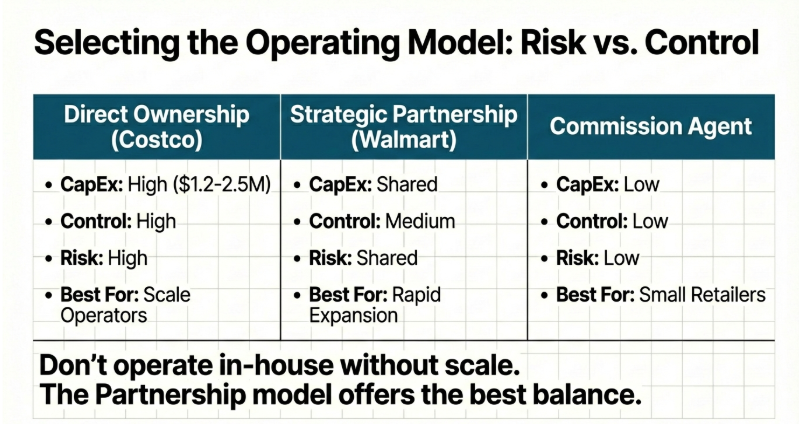
Three primary models dominate: direct ownership and operation, partnership operations, and commission agent agreements. Each model works for different retailer types, scales, and strategic goals.
Direct ownership: retailer owns fuel infrastructure, manages operations, handles procurement and compliance. High capital cost, full control, maximum profit potential but requires fuel expertise. Very few traditional retailers use this model—it’s too complex and risky.
Partnership model: retailer provides real estate, customer base, and brand integration. Fuel operator (Murphy USA, regional distributor, oil company) handles operations, procurement, maintenance, compliance. Medium capital cost (shared infrastructure investment), shared control, profit comes primarily from incremental retail sales. Most common model for large-format retailers.
Commission agent: third-party operator leases land from retailer, operates independently, pays rent/commission. Minimal retailer capital, minimal control, lowest direct profit but still generates traffic. Used by some grocery chains and smaller retailers who want fuel benefits without operational complexity.
The Hypermarket Forecourt Model (Walmart Approach)
Walmart’s model: Murphy USA leases land in Walmart parking lots, builds and operates fuel stations, pays Walmart rent (approximately $100,000-150,000 annually per location). Walmart doesn’t invest capital in fuel infrastructure—Murphy USA funds construction and owns equipment.
The arrangement benefits both parties. Walmart gets fuel stations without capital investment or operational responsibility. They integrate fuel discounts into Walmart+ (buying discounted fuel from Murphy USA for members), driving membership value and store traffic. Murphy USA gets prime real estate, massive customer traffic, and Walmart’s brand association.
The profit flow: Walmart makes money from land lease, incremental store sales from fuel traffic, and Walmart+ membership revenue. Murphy USA makes money from fuel sales and merchandise sales in their small convenience stores (separate from Walmart). Both companies profit without competing directly.
The operational separation: Murphy USA stations are physically separate from Walmart stores, with their own convenience stores selling snacks, beverages, and basic items. This prevents channel conflict—Murphy isn’t competing with Walmart’s in-store offerings because they serve quick-convenience needs rather than grocery shopping.
What works: Zero capital requirement for Walmart, predictable lease income, full control over customer experience integration (Walmart+ discounts), and no operational complexity. Murphy USA handles everything—permitting, construction, operations, compliance, employee management.
What to watch: lease agreements must clearly define pricing coordination, brand usage, and exclusivity. Walmart can’t allow Murphy USA to dramatically underprice fuel (creating customer expectation mismatches) or overprice fuel (reducing traffic benefits). The partnership requires aligned incentives.
Strategic Partnership Model (Reliance JIO-bp Example)
Reliance JIO-bp (India) demonstrates full partnership integration. Reliance (retail/telecom giant) and BP (global oil company) formed a 51-49 joint venture to operate fuel stations and mobility services. They combine Reliance’s retail expertise, customer base, and real estate with BP’s fuel operations expertise and supply chain.
The model in Western markets: Kroger-Shell partnerships follow similar logic. Kroger provides supermarket locations and customer base, Shell provides fuel supply and operational expertise. They share infrastructure costs, coordinate pricing strategies, and integrate loyalty programs.
The value creation: partnerships combine complementary capabilities. Retailers are good at customer experience, location selection, and retail operations. Oil companies are good at fuel procurement, supply chain management, and regulatory compliance. Partnerships let each party focus on their strengths.
The governance structure: joint steering committees, profit-sharing agreements, and clear decision rights prevent conflicts. Typically, retailers control customer-facing decisions (pricing, promotions, loyalty integration) while oil company partners control operational decisions (supply contracts, maintenance schedules, compliance protocols).
What works: shared risk, shared investment, and complementary capabilities. Neither party needs to develop expertise in the other’s domain. Retailers don’t learn fuel operations; oil companies don’t learn retail customer management. Each does what they’re good at.
What fails: partnerships without clear governance, conflicting incentives, or mismatched strategic goals. If a retailer wants aggressive pricing to drive traffic while the oil company partner wants profitable margins, the partnership creates constant tension. Success requires aligned goals from the start.
Commission Agent vs. Company-Owned Operations
Commission agent model: third-party operator pays rent/commission to the retailer, operates fuel station independently. Retailer has minimal involvement and minimal profit but gets traffic benefits. Common in grocery chains that want fuel presence without operational complexity.
Company-owned model: retailer directly operates fuel, employing staff, managing supply, handling compliance. Maximum control and profit potential but requires significant expertise and management attention. Very rare among traditional retailers—usually only vertically integrated companies (oil companies with retail stations) use this model.
The commission agent advantage: zero operational complexity for retailers. The agent handles everything—employees, fuel procurement, pricing, maintenance, compliance. The retailer just collects rent (typically $50,000-120,000 annually) and benefits from customer traffic.
The commission agent disadvantage: minimal control over customer experience, pricing, or loyalty integration. If the agent prices fuel poorly or runs a low-quality operation, it reflects on the retailer’s brand. Retailers can’t fully integrate commission agent stations into loyalty programs without agent cooperation.
The company-owned advantage: complete control over pricing, customer experience, loyalty integration, and operations. Retailers can use fuel strategically (pricing at-cost to drive traffic) without negotiating with partners.
The company-owned risk: fuel operations are complex, regulated, and require specialized knowledge. Retailers who tried to operate fuel in-house without expertise faced environmental violations, supply problems, and operational inefficiencies. The cost savings from avoiding partnerships rarely justify the operational risk.
What most retailers choose: partnership or commission agent models. Only very large, sophisticated retailers consider company-owned operations, and even then, partnerships usually make more sense. The complexity-to-benefit ratio doesn’t favor direct operation for traditional retailers.
How to Choose the Right Model for Your Retail Scale
Small retailers (under 50 locations): Commission agent model. You lack scale to negotiate favorable partnership terms or expertise to operate directly. Let a third-party agent handle everything while you benefit from traffic.
Mid-size retailers (50-500 locations): Strategic partnerships with regional fuel distributors or oil companies. You have enough scale to negotiate reasonable terms but not enough to build internal fuel expertise. Partnerships spread risk and investment while giving you some control over customer experience.
Large retailers (500+ locations): Partnership model with major oil companies or specialized fuel operators (Murphy USA model). Your scale justifies customized partnership agreements, shared infrastructure investment, and deep integration with loyalty programs.
Giant retailers (1,000+ locations): Consider strategic joint ventures with full governance structures, shared investment, and long-term commitments. Reliance JIO-bp style partnerships make sense at this scale because both parties invest significantly.
The capital consideration: direct ownership requires $1.2-2.5 million per location in upfront capital. Partnerships reduce this to $200,000-800,000 (shared infrastructure). Commission agents require minimal capital ($50,000-100,000 for site prep and integration). Match your model to your capital availability.
The expertise consideration: if you have zero fuel industry experience, start with commission agents or partnerships. Don’t try to operate fuel directly—the regulatory and operational complexity will create expensive problems. Build knowledge through partnerships before considering more direct involvement.
What Operational Challenges Must Retailers Solve When Adding Fuel?
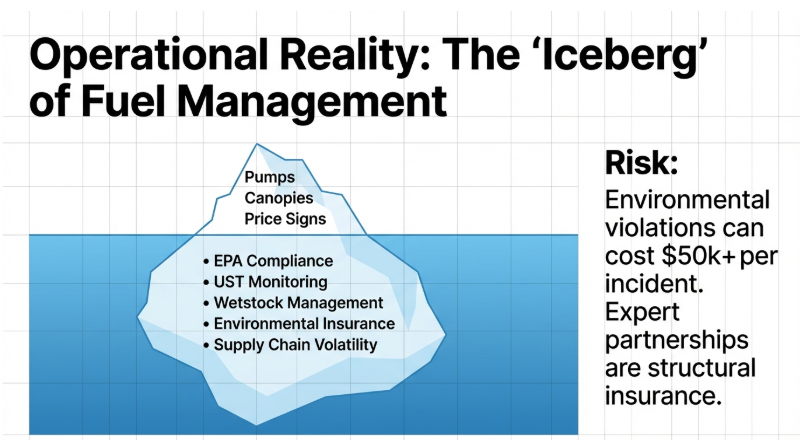
Regulatory compliance is the biggest operational challenge. Fuel operations involve environmental permits, tank monitoring, leak detection, spill prevention, and fire safety. EPA regulations, state environmental laws, and local fire codes all apply. Non-compliance creates massive liability—fines, cleanup costs, and legal exposure.
Supply chain integration challenges: fuel procurement requires relationships with distributors, negotiating contracts, managing inventory, and coordinating delivery schedules. Retail supply chains don’t prepare you for fuel supply chains—they operate completely differently.
Technology infrastructure gaps: fuel pumps need POS integration, payment processing, loyalty program connectivity, and regulatory compliance tracking. Most retail POS systems don’t handle fuel. You need specialized systems or major upgrades.
Staffing and training requirements: fuel operations require certified employees for certain tasks, safety training for all staff, and emergency response protocols. Retail employee training doesn’t cover fuel safety, environmental procedures, or compliance requirements.
Regulatory Compliance and Environmental Permits
Every fuel station requires underground storage tank (UST) registration with EPA and state environmental agencies. UST regulations mandate double-walled tanks, leak detection systems, monthly monitoring, and regular inspections. Installation requires permits, inspections, and certified contractors.
The permitting timeline: 6-18 months from initial application to operational approval, depending on jurisdiction. Urban areas with strict environmental regulations take longer. Some jurisdictions require environmental impact assessments, neighbor notifications, and public hearings before approving fuel stations.
The ongoing compliance: monthly tank monitoring reports, annual inspections, leak detection testing, spill prevention plans, and emergency response procedures. States require certified UST operators who complete specialized training. Violations trigger fines ($10,000-50,000 per incident) and potential business shutdowns.
Hire environmental consultants who specialize in fuel station compliance before starting construction. They’ll handle permitting, ensure proper installation, and establish monitoring systems. Trying to navigate EPA and state regulations without expert help guarantees costly mistakes.
Don’t skip environmental site assessments before construction. If the site has prior contamination (previous fuel stations, industrial use), you inherit liability. Proper assessments ($5,000-15,000) identify contamination before you buy or build, preventing $500,000+ cleanup obligations.
Supply Chain Integration with Existing Retail Operations
Fuel supply chains operate on daily or weekly delivery schedules based on tank capacity and sales volume. A typical station needs 6,000-10,000 gallon deliveries 2-3 times weekly. Coordinating these deliveries with retail operations (truck access, delivery timing, safety protocols) requires planning.
The supplier relationship: fuel retailers contract with distributors who deliver from regional terminals. Contracts specify pricing formulas (typically terminal rack price plus margin), delivery schedules, quality standards, and payment terms. These contracts differ completely from retail merchandise procurement.
The inventory management: fuel inventory changes constantly due to sales and temperature fluctuations (fuel expands/contracts with temperature). Retailers need wetstock management systems that track inventory, detect losses, and trigger reorders automatically. These systems don’t exist in traditional retail IT.
The payment terms: fuel distributors typically require payment within 7-10 days due to commodity price volatility. This differs from retail merchandise (30-60 day terms), affecting cash flow. Retailers need to account for faster payment cycles when planning capital requirements.
What works: partnerships where fuel operators handle supply chain entirely. They manage supplier relationships, coordinate deliveries, and handle inventory management. Retailers just need to ensure truck access and safety protocols during deliveries.
What creates problems: trying to integrate fuel procurement into existing retail procurement systems. They’re fundamentally different. Retail procurement optimizes for margin, selection, and seasonal planning. Fuel procurement optimizes for price timing, volume, and supply security. The skillsets and systems don’t transfer.
Technology Infrastructure: POS Integration and Payment Systems
Fuel POS systems need outdoor payment terminals, integration with pump controllers, real-time pricing updates, loyalty program connectivity, and compliance reporting. Standard retail POS systems don’t handle these requirements without major customization or replacement.
The pump controller integration: each fuel pump has an electronic controller that manages fueling, processes payments, and tracks volume. These controllers must connect to back-office systems for pricing updates, sales reporting, and inventory management. Integration requires specialized middleware.
The payment processing: outdoor fuel terminals face higher fraud risk and require EMV chip readers, contactless payment, and mobile wallet support. Processing fees for fuel run 1.5-2.5% (similar to retail), but the volume and transaction frequency create different requirements.
The loyalty integration challenge: connecting fuel purchases to retail loyalty programs requires shared customer databases, real-time points calculation, and discount application at the pump. This integration crosses systems—fuel POS talking to retail loyalty platforms, applying discounts based on grocery purchases.
What works: choosing fuel POS systems that have pre-built integrations with major retail loyalty platforms. Vendors like Verifone, Gilbarco Veeder-Root, and Wayne Fueling Systems offer integrated solutions designed for retail-fuel combinations. Don’t try to build custom integrations.
What fails: attempting to extend retail POS systems to handle fuel. The requirements are too different. Specialized fuel POS systems exist because fuel operations need specific capabilities (EPA compliance reporting, wetstock management, fuel pricing automation). Use proven systems instead of customizing retail platforms.
Staff Training and Safety Protocol Requirements
Fuel operations require safety training for all employees: fire hazards, spill response, emergency procedures, and customer assistance protocols. Some jurisdictions require certified fuel attendants with specific training credentials.
The specific training needs: spill containment (how to handle fuel spills safely), fire extinguisher use (different from retail fire safety), emergency shutdown procedures (how to stop fuel flow during emergencies), and customer assistance (helping customers with payment issues, fuel selection).
The certification requirements: many states require UST operator certification for personnel who manage tank monitoring, inventory, and compliance reporting. This involves 8-16 hours of training and passing certification exams. Retailers need at least one certified operator on-site or on-call.
The ongoing training: annual refreshers on safety procedures, updates when regulations change, and incident response drills. This exceeds typical retail training requirements where initial orientation suffices for most roles.
Partner with fuel operators who provide turnkey training programs. Murphy USA, major oil companies, and regional distributors offer training as part of partnership agreements. They have standardized programs covering all compliance and safety requirements.
Don’t assume retail managers can handle fuel operations without specialized training. The liability risk is too high. A fuel spill handled incorrectly can cost $100,000+ in cleanup, fines, and legal fees. Proper training ($2,000-5,000 per employee) is cheap insurance against catastrophic mistakes.
Why Is 2026 the Critical Year for Retailers to Enter Fuel Business?
Real estate availability is shrinking. Prime locations near high-traffic retail areas with sufficient space for fuel operations are limited. Once competitors secure these locations, they’re locked up for 20+ years (typical fuel station leases). Retailers who wait miss the opportunity.
The competitive dynamics shifted. Walmart, Kroger, Costco, and regional chains aggressively expanded fuel in 2023-2025. Retailers without fuel face customer retention disadvantages as competitors offer fuel rewards and one-stop convenience. The gap between fuel and non-fuel retailers is widening in customer frequency and spending.
Post-pandemic behavior changes favor one-stop shopping. Consumers consolidated trips during COVID and maintained these efficiency habits. They prefer locations offering multiple services—groceries, fuel, pharmacy, prepared food—rather than making separate stops. Retailers offering only some services lose to comprehensive competitors.
Economic uncertainty makes fuel value more important to consumers. When household budgets tighten, saving 10 cents per gallon becomes meaningful. Retailers offering fuel savings through loyalty programs gain advantage during economic stress.
Market Saturation Timing: Capturing Locations Before Competition
High-traffic locations suitable for retail-fuel combinations are finite. They need sufficient space (typically 1-2 acres for parking, fuel canopy, and tanks), highway visibility, high daily traffic counts (15,000+ vehicles), and favorable demographics (median income $50,000+).
The land grab: major retailers are racing to secure these locations before competitors. Walmart added 45 stations in 2025, Kroger added 40+, and regional chains expanded aggressively. Each location claimed by one retailer removes an option for competitors.
The long-term lock-in: fuel infrastructure creates 20-30 year commitments. Underground tanks last 20-25 years before replacement. Leases run 20+ years with renewal options. Once a competitor establishes fuel at a location, they control that advantage for decades.
The secondary locations problem: prime locations are already taken in many markets. Retailers entering late get secondary locations with lower traffic, less visibility, and worse demographics. The difference between a prime location (3,500 gallons daily) and secondary location (1,800 gallons daily) determines profitability.
Conduct market analysis identifying viable fuel locations in your operating markets. Prioritize markets where you face fuel-equipped competitors. Act quickly—every month of delay increases the chance competitors claim the best sites.
What happens if you wait: by 2027-2028, most viable locations in competitive markets will be claimed. Retailers entering after saturation either pay premium prices for less-desirable sites or skip fuel entirely, accepting permanent competitive disadvantages.
Post-Pandemic Consumer Behavior Shifts Favoring One-Stop Shopping
COVID-19 trained consumers to consolidate shopping trips. During lockdowns, people minimized outings by combining errands—groceries, fuel, pharmacy, and essentials in one trip. This efficiency habit persisted after pandemic restrictions ended.
The data: average shopping trips per household dropped from 1.6 weekly in 2019 to 1.1 weekly in 2024. Consumers didn’t stop shopping—they consolidated. Instead of separate trips to grocery stores, pharmacies, and gas stations, they choose locations offering all three.
The competitive implication: retailers offering only groceries compete for 1.1 weekly trips. Retailers offering groceries + fuel + pharmacy create reasons for 2-3 weekly visits. The frequency advantage compounds into higher annual spending.
The Amazon effect: online shopping reduced trips for non-perishables. Consumers order household goods, electronics, and clothing online, reserving in-store trips for immediacy (fuel, fresh food, urgent needs). Retailers need to dominate these immediate-need categories to maintain traffic.
What fuel solves: it’s the ultimate immediate-need category. You can’t order fuel online and wait 2 days. This forces physical visits that retailers convert into retail sales. In a world where most products are available online, fuel creates irreplaceable in-store traffic.
Economic Pressures Making Fuel Savings More Valuable to Consumers
Inflation eroded consumer purchasing power throughout 2023-2025. While headline inflation moderated, cumulative price increases reduced discretionary spending. Consumers became more price-sensitive and deal-seeking across all categories.
Fuel savings became more psychologically important. Saving $0.50 per fill-up ($1.50 weekly, $78 annually) gained attention because consumers feel fuel price changes acutely. Unlike gradual grocery inflation, fuel prices jump visibly on station signs, creating heightened awareness.
The loyalty program value perception: when consumers feel financially squeezed, tangible loyalty benefits (fuel discounts) outperform abstract benefits (points, future rewards). A 10-cent fuel discount feels more valuable than 100 rewards points worth the same $1.50 because it’s immediate and concrete.
The switching behavior: economic pressure makes consumers more willing to switch retailers for better value. Someone loyal to Albertsons might switch to Kroger if Kroger offers fuel rewards saving $80 annually. That $80 savings overcomes previous loyalty and brand preferences.
What retailers should do: market fuel savings prominently during economic uncertainty. Consumers are actively seeking ways to reduce expenses, and fuel discounts provide clear, measurable value. Use fuel as an acquisition tool when competitors are vulnerable.
How Are Retailers Future-Proofing Fuel Investments Against EV Growth?
Electric vehicle adoption creates long-term uncertainty for fuel retail. U.S. EV sales hit 9.1% of new car sales in 2024, up from 5.8% in 2022. Projections suggest 20-25% EV market share by 2030, potentially reducing gasoline demand significantly.
Retailers are responding by adding EV charging infrastructure alongside traditional fuel pumps. This hybrid approach serves both gasoline and electric vehicles, future-proofing the investment. Stations become “mobility hubs” rather than just fuel stations.
The timeline matters: most experts project gasoline demand will remain strong through 2035-2040, even with aggressive EV adoption. The existing vehicle fleet (270+ million cars in U.S.) takes decades to turn over. Today’s fuel investments have 10-15 year payback periods, well before gasoline becomes obsolete.
The EV charging opportunity: charging takes 20-30 minutes for DC fast charging, much longer than 5-minute fuel stops. This extended dwell time creates new retail opportunities—customers have time to shop, eat, or use services while charging. Retailers who adapt can increase per-visit spending.
The EV Charging Integration Strategy for Long-Term Viability
Walmart, Target, and major retailers are adding EV chargers to parking lots, often near fuel stations. This creates comprehensive mobility infrastructure serving all vehicle types. The investment is manageable—DC fast chargers cost $50,000-150,000 per unit, much less than fuel station infrastructure.
The partnership model: retailers partner with charging networks (ChargePoint, EVgo, Tesla Supercharger) who install and operate chargers. Retailers provide real estate, charging companies handle operations. This mirrors the fuel partnership model, minimizing retailer complexity.
The layout strategy: place chargers near store entrances but separate from fuel pumps. Charging customers need 20-30 minute parking, while fuel customers need 5-10 minutes. Mixing them creates traffic conflicts. Dedicated charging areas with clear signage work best.
The revenue model: retailers may charge premium electricity rates (covering costs plus margin) or offer free/discounted charging to drive store traffic. The goal is the same as fuel—use mobility needs to drive retail sales. The electricity profit is secondary to in-store spending.
What works: installing 4-8 DC fast chargers initially, expanding based on demand. This provides sufficient capacity without massive upfront investment. Monitor utilization and add chargers incrementally as EV adoption grows in your market.
Don’t bet entirely on EV charging and skip fuel. EVs are 9% of new car sales but under 2% of the total vehicle fleet. Focusing solely on EVs misses 98% of current customers. The hybrid approach serves both markets during the transition period.
Why Fuel Remains Relevant Despite Electric Vehicle Adoption
The installed vehicle base: 270+ million gasoline vehicles in the U.S. won’t disappear quickly. Average vehicle age is 12.5 years and rising. Even if every new car sold after 2030 is electric (unrealistic), gasoline vehicles will dominate the fleet through 2040.
The replacement cycle: vehicle turnover takes 15-20 years for complete fleet replacement. If EV sales hit 50% of new cars by 2030, the overall fleet reaches 50% EV around 2045. Fuel retailers have decades of strong demand before facing existential threats.
The commercial vehicle lag: trucks, vans, and commercial vehicles electrify slower than passenger cars due to range, payload, and infrastructure requirements. These vehicles represent significant fuel demand that persists longer than passenger car demand.
The geographic variation: EV adoption concentrates in coastal urban areas (California, Northeast). Rural and inland markets adopt EVs much slower due to infrastructure gaps and use cases (long distances, towing). Fuel stations in these markets remain viable longer.
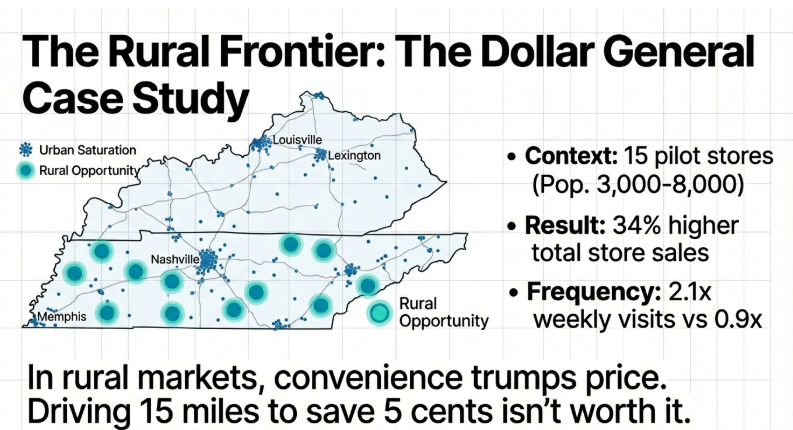
The investment horizon: fuel infrastructure investments in 2026 have 10-15 year expected returns. Even pessimistic EV adoption scenarios don’t threaten fuel demand significantly until mid-2030s. Today’s fuel investments pay back well before EV adoption creates meaningful demand destruction.
What this means for retailers: fuel investments made in 2026-2028 are safe bets. The payback period ends before EVs significantly impact gasoline demand. Don’t avoid fuel due to EV fears—the transition timeline provides ample return opportunity.
Hybrid Stations: Serving Both ICE and EV Customers
The hybrid model combines gasoline pumps and EV chargers at the same location, creating comprehensive mobility service. This maximizes location utility regardless of customer vehicle type.
Shell, BP, and major oil companies are retrofitting existing stations with EV chargers. They’re hedging against fleet transition while maintaining current gasoline business. The incremental investment (adding chargers) is modest compared to existing fuel station value.
The customer experience: hybrid stations serve all mobility needs. Families with mixed vehicle fleets (one EV, one gasoline car) can service both vehicles at the same location. This convenience creates loyalty even as vehicle fleets transition.
The operational efficiency: sharing real estate, management, and overhead across fuel and charging maximizes infrastructure return. Building separate fuel stations and EV charging locations would duplicate costs. Hybrid stations leverage existing investments.
The brand positioning: hybrid stations signal forward-thinking and environmental awareness. Customers appreciate retailers who acknowledge EV trends and accommodate all vehicles. This branding benefit enhances overall retail image.
What retailers should do: plan fuel station designs with space for future EV charger additions. Include electrical infrastructure capacity, dedicated parking areas, and layout flexibility. Retrofit costs drop significantly when planning ahead.
Extended Dwell Time Opportunity with EV Charging (20-30 Minutes)
EV charging creates fundamentally different retail opportunities than fuel. Gasoline customers spend 5-10 minutes total (fuel + quick shopping). EV charging customers spend 20-30 minutes minimum, creating time for substantial shopping.
The dwell time value: customers waiting 25 minutes for charging can browse departments, eat meals, or use services. This transforms quick convenience stops into leisurely shopping experiences. Retailers can capture higher spending per visit.
The service opportunities: fast-casual restaurants, coffee shops, seating areas with WiFi become valuable amenities during EV charging. Customers aren’t rushing—they need to wait anyway. Comfortable waiting areas convert charging time into retail spending.
The behavioral shift: EV charging customers plan for extended stops. They intentionally choose charging locations with good shopping or dining options. This creates premium positioning opportunity—stations with superior retail offerings win EV customer preference.
Tesla Supercharger placement demonstrates this. Tesla locates chargers near shopping centers, restaurants, and entertainment—places where 25-minute waits are productive. Retailers offering compelling waiting experiences (Whole Foods, Target, premium malls) get Tesla charger preference.
What retailers should exploit: position EV chargers near prepared food, coffee, seating areas, and browseable departments. Create explicit “charging lounge” areas with WiFi, charging ports for devices, and comfortable seating. Make the 25-minute wait pleasant and productive.
What NOT to do: don’t place EV chargers in remote parking lot corners away from store entrances. Unlike fuel customers (who willingly walk from pumps), EV customers will choose chargers with convenient amenities. Poor placement kills the retail conversion opportunity.
What Should Retailers Consider Before Entering Fuel Business?
Capital requirements: $1.2-2.5 million per location for full-build fuel stations, or $200,000-800,000 for partnership models. This capital needs ROI analysis—will incremental retail sales justify the investment? At what payback period?
Market analysis: does your market have sufficient competition to justify fuel defensive strategy? If you face no competitors with fuel programs, adding fuel may be unnecessary. Focus on markets where competitors already have fuel advantages.
Site suitability: does your existing real estate support fuel operations? You need 0.5-1.5 acres available space, no environmental contamination, zoning approval for fuel, and sufficient traffic access. Many urban locations can’t accommodate fuel stations.
Operational readiness: do you have partnerships or internal capabilities to handle fuel operations? If you lack both, building capabilities takes 12-24 months before launching fuel. Partner readiness determines timeline.
Site Selection Criteria: Location, Traffic Flow, and Demographics
High-traffic roads: fuel stations need 15,000+ daily vehicle traffic counts to generate sufficient volume. Low-traffic locations (under 10,000 daily vehicles) rarely achieve economically viable fuel volume.
Visibility from roadways: drivers choose fuel stations they can see from 500+ feet away. Stations hidden behind buildings or lacking road frontage underperform. Clear visibility and prominent signage are essential.
Access and egress: customers need easy entry and exit without complicated turns or traffic waits. Stations requiring left turns across heavy traffic or limited access during peak hours underperform. Simple access from both directions maximizes volume.
Demographics: median income $50,000+ correlates with higher fuel spending and retail conversion. Lower-income areas have fuel demand but lower in-store spending, reducing overall profitability. Target demographics matching your retail customer base.
Competition density: analyze existing fuel stations within 1-mile radius. Markets with 8+ existing stations are saturated—adding another station splits existing volume without growing total market. Look for underserved markets with 2-5 existing stations.
What works: sites at major intersections, near highway exits, on commuter routes, and in growing suburban areas. These locations have consistent traffic, demographic strength, and growth trajectory.
What fails: sites on side streets, in declining areas, with complicated access, or near numerous competitors. Even great retail locations may be poor fuel locations if they lack the specific traffic and access characteristics fuel needs.
Capital Investment Requirements and ROI Timeline
Full-build fuel stations: $1.2-2.5 million total capital including underground tanks ($400,000-600,000), fuel pumps and dispensers ($200,000-350,000), canopy structure ($150,000-300,000), electrical and plumbing ($100,000-200,000), paving and site work ($150,000-400,000), and compliance/permitting ($100,000-200,000).
Partnership models: $200,000-800,000 retailer capital for site preparation, shared infrastructure, and integration costs. Partners fund fuel-specific equipment while retailers handle general site improvements.
The ROI calculation: fuel stations break even or generate small direct profits. The real return comes from incremental retail sales. If a fuel station drives $2.5 million incremental annual retail revenue at 25% gross margin, that’s $625,000 annual gross profit. On a $1.5 million investment, that’s 42% ROI, with a 2.4-year payback.
The volume sensitivity: fuel volume determines retail traffic, which determines incremental sales. High-volume stations (3,500+ gallons daily) create strong retail lift. Low-volume stations (under 2,000 gallons daily) may not generate sufficient retail traffic to justify investment.
What to model: conservative fuel volume (2,500 gallons daily initially), realistic conversion rates (50% of fuel customers enter store), and achievable incremental spending ($12-15 per converting customer). Test whether these assumptions deliver acceptable ROI before committing.
What NOT to assume: don’t project fuel profitability as the primary return. If your ROI model depends on making money selling fuel, the investment won’t work. The return must come from incremental retail sales driven by fuel traffic.
Technology Stack Needed for Modern Fuel Operations
Fuel POS system: specialized point-of-sale managing pump controllers, pricing, payment processing, and sales reporting. Leading vendors: Gilbarco Veeder-Root, Wayne Fueling Systems, Verifone. Cost: $80,000-150,000 for 6-8 pump setup.
Wetstock management: monitors fuel inventory, detects losses, tracks deliveries, and calculates variance. Essential for theft prevention and regulatory compliance. Cost: $15,000-30,000 integrated with POS.
Loyalty integration: middleware connecting fuel POS to retail loyalty platforms, applying discounts, tracking member fuel purchases. Custom integration unless using pre-built connectors. Cost: $25,000-60,000 development plus $500-1,500 monthly maintenance.
Tank monitoring: automated systems tracking fuel levels, detecting leaks, measuring temperature, and generating compliance reports. Required by EPA regulations. Cost: $20,000-40,000 per station.
Payment processing: outdoor payment terminals supporting EMV chip, contactless, mobile wallets, and loyalty cards. Processing fees: 1.8-2.5% of fuel revenue.
Select integrated systems from major vendors with retail-fuel experience. Don’t mix incompatible systems or try to build custom solutions. Use proven technology stacks that handle compliance, operations, and integration reliably.
Risk Assessment: Market Volatility and Regulatory Changes
Fuel price volatility: wholesale fuel costs fluctuate 10-25% quarterly based on crude oil prices, refining capacity, and seasonal demand. These fluctuations compress margins during price increases and expand them during declines.
The price risk mitigation: partner with fuel operators who handle procurement and price risk. They use hedging strategies, futures contracts, and inventory management to smooth volatility. Retailers shouldn’t bear commodity price risk directly.
Regulatory risk: EPA regulations change periodically, requiring infrastructure upgrades or operational changes. Underground storage tank regulations tightened in 2015, forcing costly upgrades. Future regulatory changes could require additional investments.
The regulatory mitigation: build modern infrastructure exceeding current minimums. Double-walled tanks, advanced leak detection, and premium equipment reduce upgrade risk when regulations tighten. Cheap infrastructure becomes liability when standards change.
Environmental liability: fuel stations carry contamination risk. Tank leaks, spills, and historical contamination create cleanup obligations ($200,000-$2,000,000+). Environmental insurance and proper maintenance reduce but don’t eliminate this risk.
The liability protection: comprehensive environmental insurance ($5,000-15,000 annually), regular inspections, proper maintenance, and immediate response to any detected issues. Partner with operators who prioritize environmental compliance over cost cutting.
What retailers must accept: fuel operations carry risks that retail doesn’t. Environmental liability, regulatory compliance burden, and commodity price exposure are inherent. These risks can be managed through partnerships, insurance, and proper operations, but they can’t be eliminated.
How Can Small and Mid-Size Retailers Compete in Fuel Business?
Small retailers can’t match Costco or Walmart pricing or scale, but they can succeed through partnerships, niche positioning, and local market advantages. The key is choosing battles wisely—don’t try to compete on price or volume; compete on convenience, service, or specialized offerings.
Partnership strategies let small retailers access fuel without massive capital or expertise. Regional fuel distributors offer turnkey programs where they handle operations and retailers provide real estate and customers. These partnerships level the operational playing field.
Niche market opportunities exist in underserved areas—rural communities, highway corridors, resort areas—where small retailers face limited competition. These markets can’t support Walmart or Costco but need fuel services, creating opportunities for smaller operators.
Technology and payment systems are democratizing. Small retailers can offer modern payment options, loyalty integration, and customer experience quality matching large competitors. This wasn’t true 10 years ago when technology costs were prohibitive for small operators.
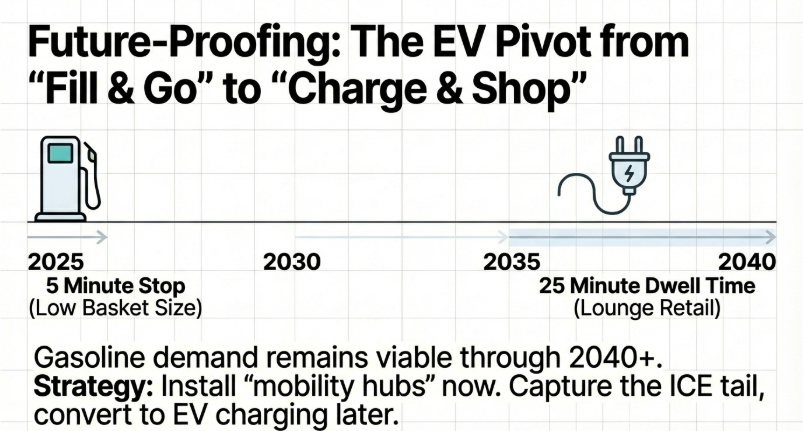
Partnership Strategies for Resource-Constrained Retailers
Commission agent partnerships: regional fuel distributors operate stations on retailer property, paying rent/commission (typically $4,000-10,000 monthly depending on volume). Retailers provide land, distributors handle everything else.
The arrangement: distributor leases land (typically 20-year agreement), builds fuel infrastructure at their cost, operates station, and pays retailers fixed rent or percentage of fuel revenue (3-5% typical). Retailer investment: minimal ($50,000-100,000 for site preparation).
The trade-off: retailers sacrifice control and direct profit for simplicity. Distributors control pricing, operations, and customer experience. Retailers just collect rent and benefit from customer traffic.
When this works: small retailers (under 50 locations) who want fuel benefits without operational complexity or capital investment. The rent provides steady income and fuel traffic drives retail sales without retailer expertise required.
Co-branding partnerships: small retailers partner with recognized fuel brands (Shell, BP, Phillips 66) for brand credibility and operational support. The fuel brand provides signage, quality assurance, and customer trust while retailers maintain more operational control than commission agent models.
The value: brand recognition matters in fuel. Customers trust Shell or BP quality over unknown brands. Small retailers partnering with major brands gain customer confidence and volume.
Niche Market Opportunities in Rural and Underserved Areas
Rural markets with populations 3,000-15,000 can’t support Walmart or Costco but desperately need fuel services. These markets often have 1-2 existing fuel stations serving the entire area, creating opportunity for additional well-placed locations.
The competitive advantage: limited alternatives mean customers choose convenience over price. A rural fuel station 5 miles closer than the alternative wins customer preference even at similar pricing. Location convenience trumps price competition in small markets.
The retail integration: rural customers consolidate shopping by necessity. A store offering fuel, groceries, and basic supplies becomes the community hub. This integration works better in rural areas than urban because customers have fewer alternatives.
Dollar General’s rural fuel strategy demonstrates this. Their test stations in Tennessee and Kentucky towns (populations 4,000-7,000) saw massive sales lifts because they became one-stop destinations for communities with limited options. Residents who previously drove 15-20 miles to Walmart now shop locally.
Highway corridor opportunities: interstate exits, tourist routes, and RV destinations need fuel but don’t attract big-box retailers. Small operators can dominate these corridors with strategic placement—the only fuel option for 30-40 miles captures all passing traffic.
What works in niches: focus on convenience and service rather than price. Offer clean facilities, good coffee, basic prepared food, and friendly service. Rural and highway customers value these factors highly because alternatives are far away.
Technology Leveling the Playing Field Against Big Box Competitors
Modern fuel POS systems, mobile payment integration, and loyalty platforms are available to small retailers at reasonable costs. What cost $500,000+ ten years ago now costs $80,000-120,000, making technology accessible.
Mobile payment apps (PayPal, Apple Pay, Google Pay) work equally well for small and large retailers. Customers don’t distinguish—contactless payment works the same at Casey’s or Costco. This eliminates a previous big-retailer advantage.
Cloud-based loyalty programs let small retailers offer sophisticated rewards without building custom systems. Platforms like FuelRewards Network, Upside, and regional programs provide turnkey loyalty that small retailers can implement quickly.
The advantage shift: technology used to favor large retailers with IT departments and development budgets. Cloud-based systems and standardized platforms democratized access. Small retailers can now match large-retailer customer experience at fraction of previous costs.
What small retailers should do: invest in modern payment terminals, integrate mobile payment options, and join established loyalty networks. Don’t try to build proprietary systems—use proven platforms that deliver big-retailer capabilities at small-retailer costs.
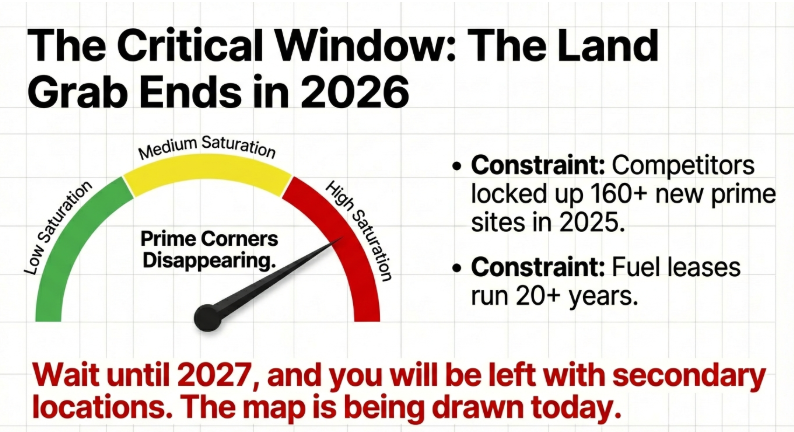
How Does Retailers Entering Fuel Business Impact Local Communities?
Job creation: each fuel station creates 2-8 jobs depending on format and hours. Larger stations with convenience stores employ 6-8 people (shifts, management), smaller automated stations employ 2-3 (maintenance, oversight). These are entry-level jobs often filled by local residents.
Price competition benefits consumers. When Costco or Walmart adds fuel, nearby fuel prices typically drop 3-8 cents per gallon within weeks. This competitive pressure saves consumers money across all fuel purchases, not just at the new retailer.
Infrastructure investment improves local areas. Fuel stations require paving, lighting, landscaping, and traffic management. These improvements enhance surrounding areas and sometimes trigger additional development.
Convenience increases for busy families. One-stop shopping for fuel and groceries saves time and reduces separate trips. This convenience particularly benefits working parents, elderly residents, and rural communities with limited options.
Job Creation and Local Economic Stimulus
Direct employment: a typical retail fuel station creates 4-6 permanent jobs (cashiers, pump attendants where required, maintenance). Larger stations with extensive convenience stores create 8-12 jobs across multiple shifts.
Construction jobs: building a fuel station employs 15-25 construction workers for 3-6 months (site prep, tank installation, building construction, compliance work). These are temporary but locally sourced when possible.
Indirect employment: fuel stations increase traffic at retail locations, driving need for additional retail staff. Walmart stores with fuel typically employ 5-8 more people than comparable stores without fuel due to higher customer traffic and sales.
The wage level: fuel station jobs typically pay minimum wage to $15/hour depending on market and position. Management positions pay $35,000-50,000 annually. These aren’t high-wage careers but provide entry-level employment and advancement opportunities.
The local hiring preference: retailers typically hire locally for fuel station positions. These jobs don’t require specialized skills, making them accessible to local residents, students, and people re-entering the workforce.
Increased Competition Driving Better Consumer Prices
Market entry effects: when major retailers add fuel, independent stations and chains must respond with price cuts to maintain volume. Studies show fuel prices in markets where Costco operates run 5-12 cents below markets without Costco presence.
The competitive radius: price impacts extend 2-5 miles from new retailer fuel stations. Stations within this radius drop prices to remain competitive, benefiting all consumers in the area, not just customers of the new retailer.
The sustained impact: competitive pricing persists as long as the retailer remains. This isn’t a temporary promotion—Costco and Walmart consistently price fuel below market, forcing ongoing competitive response from other stations.
The consumer savings: in a market with 50,000 vehicles, 5-cent price reduction saves consumers $1,950,000 annually (assuming 15,000 miles annually at 25 MPG per vehicle). This represents significant money staying in consumer pockets rather than going to fuel retailers.
The competitive discipline: big-box fuel presence prevents price gouging during supply disruptions or demand spikes. Retailers with deep pockets can maintain reasonable pricing during crises, constraining opportunistic price increases by smaller operators.
Infrastructure Investment in Underserved Markets
Rural expansion: Dollar General’s fuel program targets rural towns that historically lacked modern fuel infrastructure. Their new stations bring contemporary equipment, safety features, and environmental protection to communities that had aging, marginally compliant stations.
The upgrade effect: when modern retailers enter markets, older stations must upgrade or exit. This forces infrastructure improvement—better tank systems, modern pumps, safety features—that protects environment and improves user experience.
The accessibility improvements: new fuel stations often include ADA-compliant facilities, modern lighting, security cameras, and safety features that older stations lack. These improvements benefit all community members, especially vulnerable populations.
The tax revenue: fuel stations generate property taxes, sales taxes, and business taxes benefiting local governments. A $2 million fuel station might generate $30,000-50,000 annually in property taxes, funding schools and services.
What communities gain: modern infrastructure, competitive prices, job opportunities, and tax revenue. The impacts are tangible and sustained, unlike temporary economic development that fades.
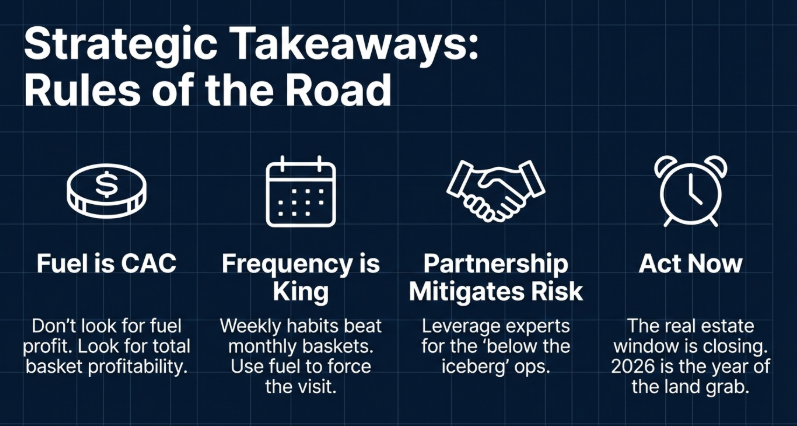
The Convenience Factor for Busy Families
Time savings: combining fuel and grocery shopping saves 15-25 minutes per week compared to separate trips. For working parents, this time savings represents 12-20 hours annually—nearly three full workdays.
The trip consolidation: families can fuel, grocery shop, pick up prescriptions, and grab prepared food in one stop. This consolidation reduces stress, saves gas (fewer trips), and simplifies busy schedules.
The weekly routine: fuel stations create predictable weekly patterns that families can build into schedules. Tuesday evening fuel and grocery shopping becomes a routine that reduces daily decision fatigue about when and where to shop.
The accessibility: fuel at major retailers means families don’t need separate stops at gas stations. Parents with children find one-stop shopping far easier than managing kids through multiple locations. This convenience factor drives strong customer preference.
What families value most: time savings, trip reduction, and predictability. Money savings matter, but busy families often prioritize convenience equally. Retailers offering both convenience and fuel savings win family customer loyalty.
The retailer fuel expansion in 2026 isn’t random it’s strategic response to structural retail challenges. Online shopping destroyed traditional foot traffic models, forcing retailers to find new traffic drivers. Fuel provides consistent, predictable, necessary visits that retail alone can’t generate.
The model works because fuel and retail complement each other. Fuel creates traffic, retail generates profit. Neither succeeds optimally alone, but together they create sustainable competitive advantages. Retailers who recognize this dynamic early lock in location advantages, customer habits, and market positions that late entrants can’t easily challenge.
The 2026 timing matters because it represents a closing window. Prime locations are disappearing, competitive advantages are widening, and customer habits are forming. Retailers acting now capture 10-15 years of strong returns before EV transition significantly impacts gasoline demand. Those who wait miss the opportunity entirely as competitors claim the best sites and lock in customer loyalty.
FAQs
Grocery chains (Kroger, Walmart), warehouse clubs (Costco), and discount stores (Dollar General) are the primary retailers entering fuel business successfully. These retailers use fuel to drive weekly traffic, increase customer frequency, and boost in-store sales. The model works best for retailers with existing large-format stores and sufficient parking space for fuel infrastructure.
Retailers entering fuel business in 2026 face a closing window of opportunity. Prime real estate locations are disappearing fast, and competitors are claiming high-traffic sites. Post-pandemic consumer behavior favors one-stop shopping, economic pressures make fuel savings valuable, and the 10-15 year payback period ensures returns before EV adoption significantly impacts gasoline demand.
Retailers entering fuel business need $1.2–2.5 million per location for direct ownership, or $200,000–$800,000 for partnership models. The investment varies by business model: commission agent arrangements require minimal capital ($50,000–$100,000), while strategic partnerships with fuel operators split costs and reduce retailer burden.
The three primary models for retailers entering fuel business are: (1) Partnership model—retailer provides real estate, fuel operator handles operations (Walmart-Murphy USA example); (2) Commission agent—third-party operates fuel station on retailer property; (3) Strategic joint venture—shared investment and governance (Reliance JIO-bp model). Most retailers entering fuel business choose partnerships to avoid operational complexity.
Fuel itself is barely profitable—margins average 10–15 cents per gallon. For retailers entering fuel business, the real profit comes from converting fuel customers into retail shoppers. Data shows fuel customers spend 40% more annually inside stores. The fuel station breaks even or loses money, but drives $2.1–2.8 million in incremental annual retail revenue per location.
Retailers entering fuel business must address: (1) Regulatory compliance—EPA permits, tank monitoring, environmental assessments; (2) Supply chain integration—fuel procurement differs completely from retail merchandise; (3) Technology infrastructure—fuel POS systems, loyalty program integration, wetstock management; (4) Staff training—safety protocols, certification requirements, emergency procedures.
Retailers entering fuel business are adding EV charging infrastructure alongside gasoline pumps, creating “mobility hubs.” This hybrid approach serves both vehicle types during the transition. Since gasoline demand remains strong through 2035–2040, current fuel investments pay back before EVs significantly impact demand. EV charging also creates longer customer dwell time (20–30 minutes), increasing in-store shopping opportunities.
Small retailers entering fuel business can compete through: (1) Partnership strategies—commission agent models minimize capital and expertise requirements; (2) Niche markets—rural areas and highway corridors with limited big-box competition; (3) Technology leveling—cloud-based POS and loyalty systems provide big-retailer capabilities at lower cost. The key is avoiding direct price competition and focusing on convenience and service.
Retailers entering fuel business gain tracking of weekly customer visits, purchase patterns, and cross-channel behavior. Fuel creates 26–52 annual touchpoints versus 12 for monthly shoppers. This data enables predictive inventory management, personalized marketing based on fuel buying patterns, and identification of high-lifetime-value customers early in their relationship.
While not mandatory in 2026, retailers entering fuel business should plan EV-ready infrastructure. Gasoline vehicles dominate the 270+ million U.S. fleet through 2040, ensuring fuel demand. However, installing electrical capacity and dedicated charging areas during initial construction costs less than retrofitting later. The hybrid approach—serving both ICE and EV customers—maximizes location utility and future-proofs the investment.

Related Posts

Instagram for Business: How to Set It Up, What to Post, and How to Actually Get Customers From It
Indiana SOS Business Search: How to Look Up Any Indiana Business, Read the Results, and Know What to Do Next